Tuesday, 3 December 2019

Kredivo’s parent firm FinAccel raises $90M to expand its credit lending platform in Southeast Asia

Singapore-headquartered FinAccel has secured $90 million in what is the largest funding round for a fintech startup in Southeast Asia as it looks to further grow its credit lending app Kredivo and build more financial services.

The financing round, dubbed Series C, for the three-and-a-half-year-old startup was jointly led by Asia Growth Fund — a joint venture between Mirae Asset and Naver — and Square Peg.

Singtel Innov8, TMI (Telkomsel Indonesia), Cathay Innovation, Kejora Intervest, Mirae Asset Securities, Reinventure, and DST Partners participated in the “oversubscribed” financing round, the startup said.

FinAccel said it has raised more than $200 million in debt and equity this year itself. It has raised $140 million in equity to date.

FinAccel operates credit lending app Kredivo in Indonesia, where it has amassed more than a million customers and is growing by a whopping 300% each year, Akshay Garg, chief executive of FinAccel, told TechCrunch in an interview.

The app enables customers to secure credit between $100 and $2,200. If a customer pays it back in full in a month, FinAccel does not charge them any fee. Else, the service levies an interest rate of 2.95%, he explained.

Kredivo’s payments option is also integrated with a number of e-commerce firms including Lazada and Shoppe and food delivery startups in Indonesia, so users can quickly access the credit to purchase things and pay the app later.

Credit lending apps are increasingly gaining popularity across the globe, but especially in Southeast Asian markets where the penetration of credit card remains low — hence there are very few people with a traditional credit score. This has created an opportunity for startups to look at other metrics to determine who should get a loan.
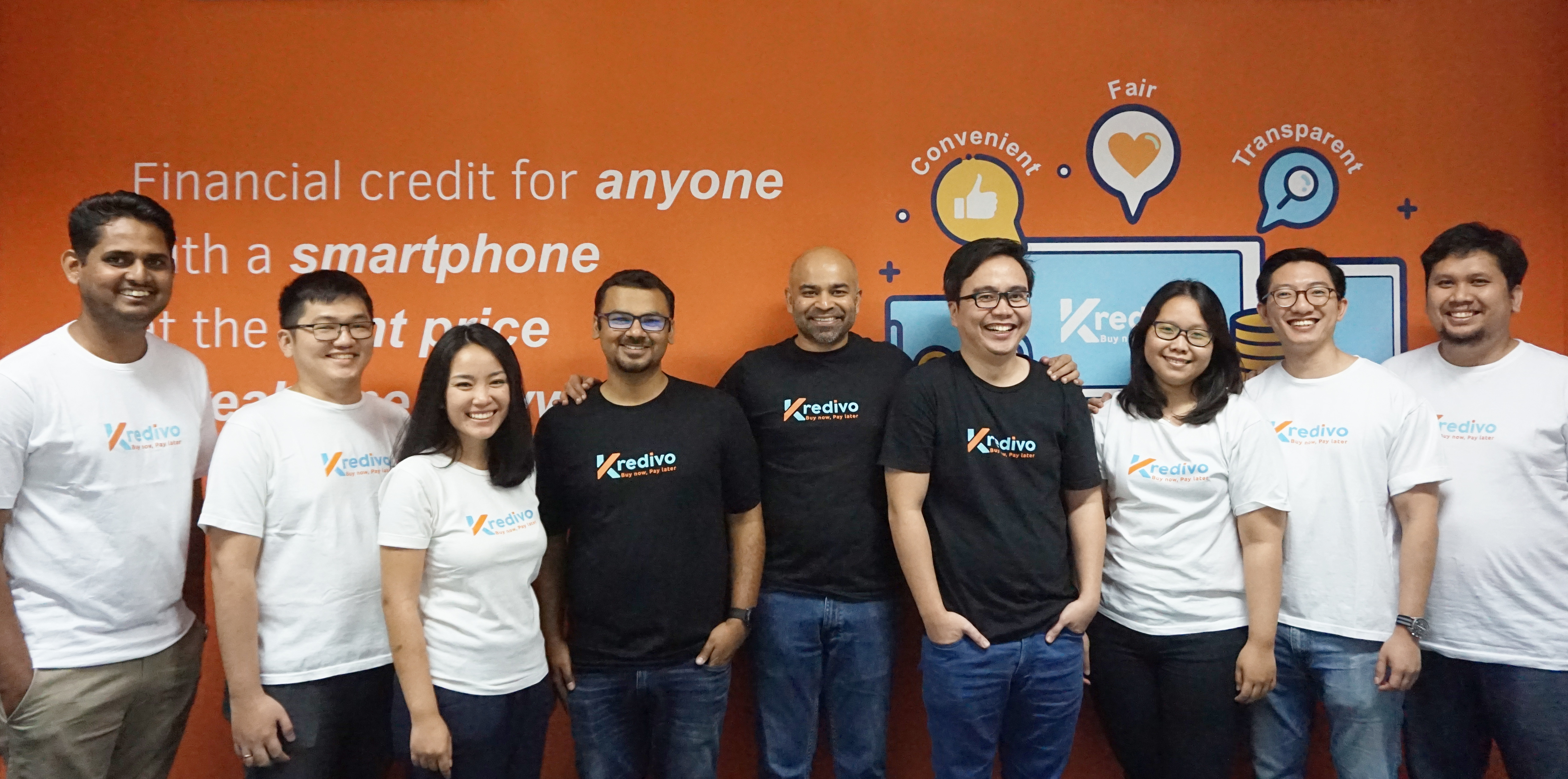
FinAccel’s team poses for a picture

Garg said Kredivo looks at a range of data points including the kind of smartphone model a customer is using, and the apps they have installed on it. “Basically what we’re doing is almost like creating a user profile about the user using a combination of different data signals that come from the existing credit bureaus, the telcos, the e-commerce accounts, the bank accounts, and the users themselves,” he said.

“All of that creates a 360-degree overview of the customer that helps us determine the risk factors and decide whether to issue the credit,” he added. As of today, Kredivo is only approving about one-third of the applications it receives.

Jikwang Chung, Managing Director of Mirae Asset Capital, the strategic investment arm of Mirae Asset, said in a statement that FinAccel is one of the leading companies in Southeast Asia that is able to “combine a strong technology DNA with top-tier risk management and a bold vision of financial inclusion.”

FinAccel, which works with banks to finance the credit to customers, has evaluated more than 3 million applications to date and disbursed nearly 30 million loans. Garg said the startup is now working to develop more financial services such as low-interest education and healthcare loans.

In the next three to four years, it aims to grow to 10 million users and expand to other Southeast Asian markets such as Philippines.

A handful of other startups also operate in this space in Indonesia. C88, which also offers credit to customers, last year raised $28 million in a financing round led by Experian.


from Startups – TechCrunch https://ift.tt/2DQ9iJv
via IFTTT

Fulcrum, which provides freelance placement opportunities for technical projects, raises $1 million

La Jolla, Calif.-based Fulcrum, a job-placement company for technical projects, has raised $1 million in a seed round of funding, led by local technology investment firm Greatscale Ventures with participation from several private co-investors, the company said.

The company has what it calls a fully compliant service for hiring freelancers onto technical projects that had previously only been the purview of full-time staffers — or work that would have been outsourced to pricey consulting firms.

Fulcrum says that its job-placement platform meets the regulatory requirements in 90 countries and is designed to give businesses the ability to design, manage and execute projects on demand.

The company scrapes all marketplaces that freelancers currently use and onboards them through its own service so that they can work effectively with large corporations.


from Startups – TechCrunch https://ift.tt/2Y62DUK
via IFTTT

Diversity-focused VC fund Harlem Capital debuts with $40M

Harlem Capital has upgraded from angel syndicate to full-fledged venture capital fund, closing its debut effort on an oversubscribed $40.3 million.

The firm was launched by managing partners Henri Pierre-Jacques and Jarrid Tingle in New York City’s Harlem neighborhood in 2015. The pair have since graduated from Harvard Business School and hired two venture partners, Brandon Bryant and John Henry, and two senior associates to help expand their portfolio. The over-arching goal: invest in 1,000 diverse founders over the next 20 years.

“We fundamentally believe we are a venture fund with impact, not an impact fund,” Pierre-Jacques tells TechCrunch. “The way we generate impact is to give women and minority entrepreneurs ownership.”

Capital from Harlem Capital Partners Venture Fund I, an industry-agnostic vehicle that invests in post-revenue businesses across the U.S., will be used to lead, co-lead or participate in $250,000 to $1 million-sized seed or Series A financings. To date, the team has backed 14 companies, including B2B feminine hygiene product Aunt Flow, gig economy marketplace Jobble and pet wellness platform Wagmo. Harlem Capital plans to add another 22 businesses to Fund 1.

You need diversity funds like ourselves to get this market anywhere close to parity. Harlem Capital managing partner Jarrid Tingle

With its first fund close, Harlem Capital becomes one of the largest venture capital funds with a diversity mandate. Despite an increasing amount of punishing data exposing the gender and race gap in venture capital, minority founders continue to rake in just a small percentage of funding each year. According to a RateMyInvestor and Diversity VC report released earlier this year, most VC dollars are invested in companies run by white men with a university degree. Other recent data indicates startups founded exclusively by women raised just 2.2% of overall VC funding in 2018, with numbers on pace to increase only slightly in 2019. Meanwhile, the median amount of funding raised by black female founders, as of 2018, was $0.

The stark contrast in funding for female versus male entrepreneurs or white women versus black women founders is in part a result of a lack of diversity amongst general partners at venture capital funds and amongst the limited partners that choose which venture capital funds to provide capital. While there’s little data available on diversity of LPs, 81% of VC firms didn’t have a single black investor as of 2018.

“There’s no rational reason why this problem exists,” Tingle tells TechCrunch. “It persists because VC funds in general have been closely held and clustered around Silicon Valley. They come from particular schools with particular networks with a small head count that doesn’t turn over frequently. Some firms have strategically added a few partners here and there, but not enough to change the organization. You need diversity funds like ourselves to get this market anywhere close to parity.”

“A lot of investors are frankly missing out on opportunities,” Tingle adds.

Having met through the Management Leadership for Tomorrow Program, a nonprofit organization identifying a new generation of leadership, Tingle and Pierre-Jacques have built a prolific internship program at the firm. With as many as six interns admitted each quarter, the goal is to train future investors of color.

Limited partners in Harlem Capital Partners Fund I include TPG Global, State of Michigan Retirement Systems, the Consumer Technology Association and Dorm Room Fund.


from Startups – TechCrunch https://ift.tt/34HwB3X
via IFTTT

Score Cyber Monday savings on TechCrunch Sessions 2020 passes

Have we got a Cyber Monday deal for you. TC Sessions: Robotics+AI (March 3) and TC Sessions: Mobility (May 14) are coming back to California in 2020 with early bird tickets starting at $275 and $250 respectively. But if you buy your pass today, you’ll save an extra 15 percent on each event. How sweet is that?

Don’t delay, startuppers. Buy your pass to TC Sessions: Robotics & AI and/or TC Sessions: Mobility before this one-day deal expires promptly tonight at 11:59 pm PT.

Oh, and did we mention that all Startup exhibitor tables are also 15% off? Tables are good for early-stage startups and comes with 4 tickets and demo area at the conference. Book table for Mobility here or one for Robotics here.

It doesn’t take artificial intelligence to recognize great opportunity, and you’ll find plenty of it at our day-long exploration of the latest issues, trends, tech and products in robotics+AI and Mobility. At each of last year’s events, 1,000+ of each category’s top minds and makers gathered for live interviews, demos and workshops featuring world-renown technologists, founders and investors — not to mention world-class networking.

Past Robotics+AI Speakers:

  • Marc Raibert, Boston Dynamics
  • Melonee Wise, Fetch Robotics
  • Colin Angle, iRobot

Past Mobility Speakers:

  • Ted Serbinski, Techstars
  • Nils Wollny, Holoride
  • Ken Washington, Ford

We’re just getting started on building out the event agenda and we’ll announce plenty more speakers and panelists over the coming months, so keep checking back.

Mark your calendar, join us at UC Berkeley on March 3 for TC Sessions: Robotics or come on by to San Jose on May 14 for TC Sessions: Mobility and spend an entire day with the best and brightest minds and makers. Don’t miss this Cyber Monday opportunity to save an extra 15 percent to Robotics+AI and/or Mobility.


from Startups – TechCrunch https://ift.tt/2OHWV8h
via IFTTT

Monday, 2 December 2019

Accel closes new $550M fund for India

Accel, one of the world’s most influential venture capitalist firms, is becoming more bullish on India.

The Silicon Valley-headquartered firm, which largely focuses on early stage investments, said today it has closed $550 million for its sixth venture fund in India.

This is a significant amount of capital for Accel’s efforts in India, where it began investing 15 years ago and has infused roughly $1 billion through all of its previous funds combined.

Anand Daniel, a partner for Accel in India, told TechCrunch in an interview that the VC fund will continue to focus on identifying and investing in seed and early stage startups.

But the fund realized that it needed more money so that it could actively participate in follow-on rounds (later stage financing rounds) of its portfolio startups. The announcement today follows Accel’s similar recent push in Europe and Israel, where it closed a $575 million fund.

Like in many other markets, Accel’s track record in India is quite impressive. It participated in the seed financing round of e-commerce firm Flipkart, which was then valued at $4 million post-money. Walmart bought majority stake in Flipkart last year for $16 billion.

Accel, which has nine partners and more than 50 members in total in India, also invested in the seed round of SaaS giant Freshworks, which is now valued at over $3 billion, food delivery startup Swiggy, also valued at north of $3 billion, and recently turned unicorn BlackBuck.

The VC firm says 44 startups in its India portfolio today are valued at over $100 million. In total, including Flipkart’s $21 billion market value, Accel’s portfolio firms have created $44 billion in market value.

More to follow…


from Startups – TechCrunch https://ift.tt/2r5nQC4
via IFTTT

Cyber Monday Disrupt Berlin special: Get a $200 gift with purchase

The holiday season is officially on, and Disrupt Berlin 2019 opens  its doors in just nine days. We’re ready to celebrate both occasions in festive style with a one-day Cyber Monday special. Buy a pass to Disrupt Berlin* today, 2 December, and you can pick any gift — up to $200 in value — from the TechCrunch Gift Guide.

Not familiar with our gift guide? You’re in for a treat. TechCrunch folk verge on the maniacal when it comes to choosing the gadgets, gear and services we use. Since we love to share, we curate the guide and pack it with absolutely awesome stuff.

Once you purchase your pass* to Disrupt Berlin today, we’ll contact you the week after the conference ends to get your preferred selection from the gift guide priced up to $200 (US). Cross a name off your holiday shopping list and choose a gift for a loved one, a friend or your kids. And if you decide to pick a cool gadget for yourself — hey, who are we to judge?

If you want to talk about gifts that keep on giving, Disrupt Berlin tops the list. This international conference boasts thousands of attendees from more than 50 countries, 200 media outlets and hundreds of early-stage startups exhibiting the very latest innovations across the tech spectrum. It’s opportunity on steroids.

We packed the Disrupt Berlin agenda with world-class speakers, presentations, in-depth Q&A Sessions, panel discussions and workshops. The cream of the international early-stage startup crop will compete in the Startup Battlefield pitch competition for a $50,000 equity-free prize and bask in the spotlight of investor and media attention.

You’ll find infinite networking opportunities in Startup Alley. Our expo floor will be home to hundreds of pre-Series A startups eager to connect and impress. While you’re in the Alley, be sure to meet our Disrupt Berlin 2019 TC Top Picks — a cadre of innovative startups handpicked by TechCrunch editors.

This year, the TC Hackathon finalists will pitch the products they built in less than 24 hours live on the Extra Crunch stage. If you’re looking for creative devs in your startup — or if you just appreciate code poetry — this is a great opportunity to see the solutions these highly skilled competitors created to address real-world problems.

And CrunchMatch, our free business match-matching service available to all attendees — makes networking easier, more productive and less stressful. Who doesn’t love that?

Disrupt Berlin 2019 takes place on 11-12 December. Tis’ the season — take advantage of our one-day Cyber Monday celebration. Buy a pass to Disrupt Berlin 2019 today*, and you get to choose a gift — worth up to $200 — from the TechCrunch Holiday Gift Guide. Come and join us in Berlin!

Is your company interested in sponsoring or exhibiting at Disrupt Berlin 2019? Contact our sponsorship sales team by filling out this form.

*Purchase must occur before 11:59pm CET on 2 December and must be a full-priced pass without any additional discounts applied. You will be contacted via the email address you submit in your registration after the event has been completed to provide your preferred gift selection valued up to $200 USD.


from Startups – TechCrunch https://ift.tt/2rIDH9C
via IFTTT

Uncapped raises £10M to offer ‘revenue-based’ finance to growing businesses

Uncapped, a London headquartered and Warsaw-based startup that wants to provide “revenue-based” finance to growing European businesses, is officially launching today and disclosing that it has raised £10 million in funding.

The capital is a mixture of equity funding and debt (money it can use for lending), and sees the fintech company backed by Rocket Internet’s Global Founders Capital, White Star Capital, and Seedcamp.

I understand a number of angel investors also participated. They include Robert Dighero (Partner at Passion Capital), Carlos Gonzalez-Cadenas (COO of GoCardless) and David Nolan and Kevin Glynn (founders of Butternut Box).

Founded by “serial entrepreneur” Asher Ismail (who was most recently CEO of Midrive), and former VC Piotr Pisarz, Uncapped has set out to use various marketing, sales and accounting data to be able to offer finance for young businesses based on their current (and projected) revenue.

Specifically, Uncapped says it will enable founders to access working capital between £10,000 and £1 million for a flat fee of 6% interest. It’s being pitched as a smart alternative for growing companies that don’t want to give away equity in return for capital to help grow.

“The first decision that entrepreneurs need to make when raising finance is whether to give away a portion of equity in their company, or take on debt,” explains Ismail. “Equity is a slow and very expensive way to fund growth, while loans add more risk. We’re creating an alternative that sits between debt and equity financing, while offering the benefits of both. We started Uncapped so that entrepreneurs wouldn’t have to give up a piece of their company or put up their house”.

Ismail says that Uncapped provides entrepreneurs with access to capital without the need for “personal guarantees, credit checks, warrants, or equity,” and promises to move a lot quicker than investors, or for that matter, more traditional forms of debt finance, can.

“We don’t require customers to share any business plans, cap tables, or pitch decks,” he adds. “All we need is to verify their business performance. We connect to the business’ existing sales and marketing platforms, like Stripe, Shopify and Facebook. Revenue-based finance also gives founders the flexibility to repay less when their sales slow or the market hits a downturn”.

The only stipulation is that businesses must be based on online payments and have at least nine months trading history. This makes Uncapped particularly suitable for companies operating e-commerce, SaaS, direct-to-consumer, gaming and app development businesses.

“For example, our first customer was online menswear brand, L’Estrange,” Uncapped Pisarz tells me. “For e-commerce businesses, December is typically the most challenging time to invest in growth, as inventory and marketing costs are at a peak but Christmas sales have not yet come through. We were able to provide the business with an advance within three days”.

Meanwhile, Ismail claims that Uncapped is the first company of its kind to launch in Europe (which is somewhat of a stretch) and that venture capital — although very different — is probably the closest alternative form of financing.

“Despite the $35 billion invested in Europe by VCs this year, many companies do not fit the venture model,” he says. “They might be a family business that doesn’t intend to sell, an entrepreneur focused on more of a niche market, or minority who may be overlooked by traditional funders. Whilst VCs will often meet 1,500 companies and back just five of them a year, we have the ability to provide 100s of businesses with growth capital for a flat fee much faster and without sacrificing equity at an early stage”.


from Startups – TechCrunch https://ift.tt/2Y6Gt4A
via IFTTT