Wednesday, 30 October 2019

New startup Capital wants to reintroduce founders to venture debt

Why raise venture capital when you can raise debt and keep your equity?

That’s the question a whole slew of new financial technology companies are hoping entrepreneurs will ask themselves as they begin to think about collecting outside capital for their businesses. Clearbanc made waves with its “20-Minute Term Sheet” campaign, with a goal of backing 2,000 businesses with $1 billion in non-dilutive capital by the end of 2019. Now, Capital is launching to educate founders about the possibility of debt funding.

Founded by former Draper Fisher Jurvetson (now known as Threshold Ventures) investor Blair Silverberg, Csaba Konkoly and Chris Olivares, Capital is launching today with $5 million from Future Ventures, Greycroft, Wavemaker and others. Additionally, it’s raised from “prominent institutional pools of capital” to invest between $5 million and $25 million in promising companies, determined using “The Capital Machine.”

Blair

Capital co-founder Blair Silverberg.

Capital’s underwriting technology, dubbed The Capital Machine, determines if businesses have the growth potential necessary for an infusion of debt (by analyzing revenue and other financial considerations), then delivers term sheets within 24 hours. The expedited process cuts out the time-consuming elements of pitching venture capitalists, the company says, allowing businesses to go from zero to $5 million—or more—in a matter of hours.

For companies that are’t ready for a debt round, or who don’t meet Capital’s qualification, the company is offering access to a free calculator that determines the cost of a company’s capital based on their fundraising and valuation data.

“We are trying to create a business that is the place that all founders go to start their fundraising process,” Silverberg tells TechCrunch. “We just want entrepreneurs to understand that step one in building a balance sheet is to understand your cost of capital. Step two is you can now use that to compare your financing options. We hope we can make this process simpler and more transparent.”

Capital charges a 5% to 15% flat fee on its capital, investing a maximum of $50 million over time. The company has ambitions of becoming a holistic investment bank of sorts, says Silverberg, ready and willing to advise companies on fundraising possibilities and connect them with VCs for future deals.

Historically, Silverberg explains, venture capital dollars went to risky upstarts poised to disrupt a category. Today, loads of equity funding is funneled into predictable business models that could be funded entirely with non-dilutive capital: “I saw what the venture process was like,” Silverberg said, referencing his stint at DFJ. “Tech companies do not utilize debt … this is extremely expensive for founders.”

There’s a culture surrounding venture capital fundraising in Silicon Valley and beyond. One in which startups seek to become ‘unicorns,’ hoping for stories on this very sight to laud their accomplishments—including the loads of venture capital dollars they’ve pulled in. In reality, much of that capital is plowed into things like Facebook and Google to fuel digital ad campaigns, which is not how VC is intended to be used and can result in founders taking a company public with just a few percentage points of ownership.

Solutions like Capital, Clearbanc, Lighter Capital and others, should remind entrepreneurs that venture capital isn’t the only route to getting a company off the ground and can be raised in addition to venture debt.

“There’s no excuse for not knowing your cost of capital,” Silverberg adds.


from Startups – TechCrunch https://ift.tt/2BWmlrI
via IFTTT

Video news startup Brut raises $40M, officially launches in the U.S.

Digital media startup Brut is announcing that it has raised $40 million in Series B funding. The money will be used, in part, to finance its launch in the United States.

CEO Guillaume Lacroix said that that he and his co-founders all come from the French TV industry, where they were all “frustrated not to be able to follow up the conversation on social.” So they created Brut as a way deliver video news that felt conversational and authentic, hoping to spark viewer conversation, then take advantage of that commentary to find future stories.

“We always always say to journalists, ‘Forget the audience, think about your two best friends,'” Lacroix told me. “‘Would you be excited to have this conversation tonight with your friends? If yes, let’s do it.'”

The publisher focuses on topics like social good and social impact — for example, it published the first viral video featuring climate change activist Greta Thunberg. Lacroix argued that Brut’s audience is looking for solutions, not just problems, in contrast to the “negative news cycle” that they see on traditional media.

“People are not waiting anymore — they don’t wait for institutions to do it, they don’t wait for the collectivity to do it,” he said. “It’s very inspiring to see someone who takes even a small action.”

At the same time, he doesn’t want Brut’s journalists to veer too heavily into advocacy or activism themselves: “We don’t do a call to action, we’re not activists, we don’t point a finger. We just shine a light on people who are trying to do something to change the world.”

In many ways, Brut seems to check off the same boxes (it aims to reach a millennial/Gen Z audience with short videos on Facebook, Instagram and Snapchat) that many U.S. digital media startups did before they started to struggle and consolidate over the past few years.

But Lacroix said the startup’s approach is working — not just in terms of reaching an audience, but also building a real business. Brut is already profitable in France, and it plans to be profitable in the U.S. within three years.

Asked about whether he’s worried about relying on social platforms to reach his audience, Lacroix argued that even if you focus on publishing on your own website, you’re reliant on Google for traffic.

“For me, it’s not a problem of distribution, if you’re diversified enough,” he said. “It’s a problem of: What’s your business model? Why did Spotify explode from day one? They have a global DNA. It’s exactly the same for us.”

For example, Lacroix said that Brut’s audience is concerned about many of the same issues no matter what country they’re in. And the company is able to produce content for them in a relatively low cost way, because it can shoot a video in French or English, then add subtitles in a variety of languages — most audiences won’t even notice since they’re watching on their phones, with the sound off.

To be clear, Brut hasn’t exactly been ignoring the U.S. market before this. The company said it has an audience of 30 million daily active viewers across the globe, including in the United States, and it opened an office in New York City a couple of years ago. By “launching” here, Brut means it’s hiring an advertising salesforce to start monetizing that audience.

The company previously raised 10 million euros (approximately $11.1 million) from Kima Ventures, according to Crunchbase. The new funding was led by Red River West and Blisce, with participation from Aryeh Bourkoff, Eric Zinterhofer and others.

“When deciding where to invest, we look for mission-driven companies whose values are aligned with our own,” said blisce founder and CEO Alexandre Mars in a statement. “Like blisce’s previous investments in Spotify, Pinterest and Bird, we believe that Brut.’s unique global approach represents a special competitive advantage, as well as an understanding that business success and positive social impact are inextricably linked.”


from Startups – TechCrunch https://ift.tt/2WniA8a
via IFTTT

Field management software startup Workiz raises $5 million Series A

Workiz, a startup whose software helps field service professionals manage their work, said today it has raised $5 million in Series A funding. The funding was led by Magenta Venture Partners, with participation from returning investor Aleph. The company announced the launch of Workiz Voice, an Amazon Alexa-powered feature that allows the app to be controlled with voice commands, making it safer to use while field service workers driving.

Magenta Venture Partners general partner Ran Levitzky will join Workiz’s board of directors. The Series A brings Workiz’s total funding so far to $7.3 million. The company says it grew 247% last year and CEO Adi Azaria told TechCrunch that the company currently has thousands of customers in the U.S. and Canada. Many are home or equipment maintenance companies, including locksmiths, garage door repair, junk removal, appliance repair and carpet cleaning businesses. The software has also been used by medical transport companies, including Trinity Air Medical, to manage highly-time sensitive delivery of organ donations to their recipients.

Targets SMBs field service businesses with less than 50 employees, but can scale up to organizations with 600 technicans, and franchises, says CEO. Include locksmiths, garage door repair, junk removal, appliance repair and carpet cealning businesses. Also used by international organ donor and medical transport companies, makeup companies, and environmental waste disposal companies. LIke Trinty Air Medical, which uses Workiz to manage organ donations and make sure thye are delivered in time.

Workiz’ new funding is being used on its automation platform for field service workers and Workiz Voice, as well as hiring for its North American team and operations.

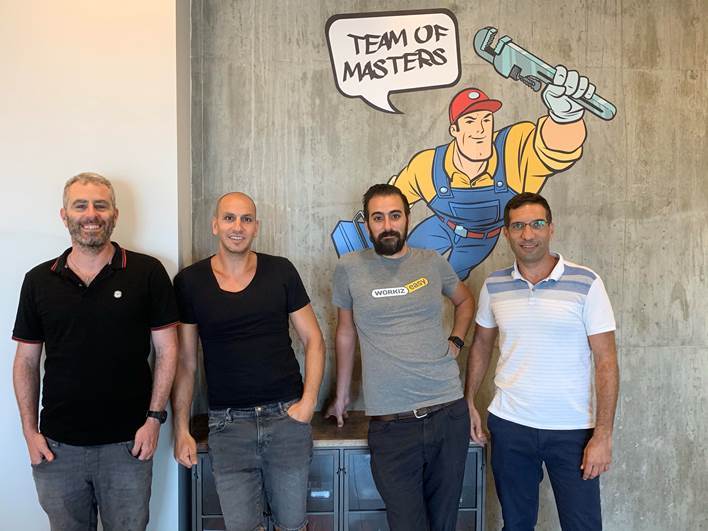
Workiz's founders

Workiz’s founders

The startup was founded in 2015 by a team including Idan Kadosh and Erez Marom, who worked as locksmiths for over 15 years in San Diego, California. They were frustrated by the field service management software options available and relies on pen, paper and Excel spreadsheets to manage their business. They also carried multiple cell phones, since most customer appointments were arranged by phone calls and they could not hide their personal numbers.

Workiz was created to give field service companies a full set of tools, including the ability to monitor interactions between technicians and customers, keep detailed records of client calls and texts, send clients reminders, track advertising spending and effectiveness and process credit card payments.

“At Workiz, we have a vision to transform tradespeople into business professionals, and the Workiz platform is able to successfully do so. While 75% of small businesses close within their first five years of business, businesses who are using Workiz are able to slash that number down to just 20%,” said Azaria.

About 52% of field services companies still rely on pen and paper to manage their businesses, presenting a growth opportunity for Workiz. To get them to switch, Workiz provides free help for onboarding, which can be completed in as little as one or two days. The software syncs with QuickBooks or CSV files.

The startup says Workiz Voice, which enables workers to look up job schedules, sort through leads, communicate with team members or clients and find directions to their next job, is the first feature of its kind on the market. It helps Workiz Voice differentiate from other field service management software like Jobber or HouseCall Pro.

In a press statement, Levitzky said “We are constantly on the lookout for exciting companies transforming industries, and Workiz ticked all of the boxes. The company’s approach levels the playing field so that businesses of all sizes can better secure and manage job opportunities, given the on-demand nature of the field service industry.”


from Startups – TechCrunch https://ift.tt/33bhUVK
via IFTTT

Want a free Innovator pass to Disrupt Berlin 2019? Apply to volunteer

If your budget simply can’t manage a line item for a ticket to Disrupt Berlin 2019, we have exciting news for you. Volunteer for our work exchange program, and we’ll give you a free Innovator pass good for both days of the show (11-12 December). We have a limited number of volunteer positions, and applications close Thursday, 31 October.

Don’t wait — apply to our volunteer work exchange and attend Disrupt Berlin for free.

It takes a lot of hands and a lot of work to produce a world-class tech event, and you’ll have a front row seat to how it all gets done. You’ll also be a big part of making Disrupt an outstanding experience for all attendees.

We might ask you to wrangle speakers, register attendees, scan tickets, stuff goodie bags, assist with other marketing activities, direct attendees, place signage or something else entirely. You’ll work hard, but you’ll also have plenty of time to enjoy that Innovator pass access.

Ready for the fine print? Here’s what you need to know. The Disrupt Berlin volunteer dates are 10-12 December. To be considered, all volunteers must

  • Be at least 18 years old
  • Submit an application by Thursday, October 31
  • Attend a mandatory orientation training on Tuesday, 10 December at Arena Berlin
  • Be available for a total of 10 hours over the course of all three days Shifts range between 2 to 5 hours and may start as early as 6 a.m. or end as late as 11 p.m.
  • Provide your own travel, lodging and meals

We’ll assign volunteer schedules 2-3 weeks before the event, and we’ll notify you — whether we accept your application or not — by Wednesday, 6 November.

We keep dangling the free Innovator pass and for good reason. With it, volunteers have access to the full Disrupt agenda, all stages — including the Startup Battlefield competition — exclusive video content access after the event ends, interactive workshops, more than 400 startups and sponsors in Startup Alley, networking events, the full attendee list via Disrupt Mobile App and CrunchMatch, the attendee networking platform.

As a volunteer at Disrupt Berlin 2019, you’ll see everything that goes into producing a large-scale tech event, meet great people and still have time to explore and network. Applications close on 31 October, so apply to volunteer today!

Is your company interested in sponsoring or exhibiting at Disrupt Berlin 2019? Contact our sponsorship sales team by filling out this form.


from Startups – TechCrunch https://ift.tt/36iXdJN
via IFTTT

Let’s have a word about what3words with Clare Jones at Disrupt Berlin

Addresses are ambiguous, not precise enough or don’t even exist in some places. what3words wants to map the entire world and overhaul addresses three words at a time. That’s why I’m excited to announce that what3words Chief Commercial Officer Clare Jones is joining us at TechCrunch Disrupt Berlin.

The startup has divided the world in 3 meter squares. Each square has been assigned three words. This way, it’s easy to read, easy to write and even easy to say. And more importantly, it’s unique.

And sometimes, simple ideas can be incredibly powerful. For instance, if you’re driving, it’s much faster to say three words to define an address on your navigation system than a full address.

It’s also more precise. If you’re heading to a huge building, you want to arrive at the entrance of the building, not on the other side. It’s incredibly frustrating when it happens — I nearly missed a train when a GPS navigation system led me to the wrong side of the tracks. This could be particularly useful for ride-hailing apps for instance, as they usually only let you enter an address.

And then, there are countries that never had a good address system in the first place. For instance, Lonely Planet added what3words addresses to its Mongolia travel guide. It is much easier to read three words in a book and type them on your phone, instead of tapping GPS coordinates for instance.

It also opens up a lot of new markets for e-commerce companies. In some countries, customers don’t have a good way to indicate where they live. An e-commerce website can add what3words support to add new delivery locations.

There are many other use cases. Emergency services, governments and humanitarian projects could also leverage what3words to improve communication and become more efficient. And I can’t wait to hear Clare Jones describe how people have been using what3words.

Buy your ticket to Disrupt Berlin to listen to this discussion — and many others. The conference will take place December 11-12.

In addition to panels and fireside chats, like this one, new startups will participate in the Startup Battlefield to compete for the highly coveted Battlefield Cup.

what3words is the world's first addressing system designed for voice – every 3m x 3m square in the world has been assigned an address made of just three words from the dictionary. These 3 word addresses can be used to route cars or drones, used as an address when ordering online, or simply given as a meeting point for a picnic in the park. what3words is used in 170 countries and is being adopted by governments all around the world as an official addressing system. Its investors include Daimler, Intel Capital, Aramex and Deutsche Bahn.

Clare is the Chief Commercial Officer of what3words; prior to this, her background was in the development and growth of social enterprises and in impact investment. Clare was featured in the 2019 Forbes 30 under 30 list for technology and is involved with London companies tackling social/environmental challenges. Clare also volunteers with the Streetlink project, doing health outreach work with vulnerable women in South London.


from Startups – TechCrunch https://ift.tt/31WXa2R
via IFTTT

ShareGrid acquires UK peer-to-peer film and camera rental community BorrowFox

ShareGrid, the U.S.-based marketplace for sharing, buying and selling film and photography equipment, has acquired the U.K’s BorrowFox as part of its international expansion plans.

BorrowFox operates a “peer-to-peer” film and camera rental community that lets people rent out their under-utilised gear. ShareGrid says it expects to launch in the U.K. in 2020 (where it will compete with the likes of Fat Lama).

Terms of deal remain undisclosed, although I understand ShareGrid is acquiring all of BorrowFox’s assets outright. The two companies aren’t disclosing if it was a cash or stock deal or mixture of the two, or who BorrowFox’s investors were.

Meanwhile, I’m told that BorrowFox’s founders, Arthur Pierse and Alastair Woods, won’t be joining ShareGrid.

In the U.S. ShareGrid lets users rent film and camera equipment from each other, including cinema cameras, still cameras, lenses, audio equipment, drones, lighting equipment, gimbals and other accessories, as well as studio spaces, locations and production vehicles.

The idea behind the service is to help creatives access world-class equipment at lower rental fees, and earn an income from their unused gear. The company also offers a buy-and-sell service, custom production quotes, and instant insurance, acting as a “one-stop shop” for filmmakers, photographers and production professionals.

Following the acquisition, ShareGrid says it will host over 100,000 users, with more than $1 billion worth of film and camera equipment available on its combined platform. Once the acquisition complete and ShareGrid has launched in the U.K., existing BorrowFox members will be asked to transfer their account to ShareGrid.

“At ShareGrid, our mission is to enable all filmmakers and photographers, regardless of background, budget or location, to have access to cutting-edge and affordable equipment,” says Marius Ciocirlan, co-founder and CEO of ShareGrid in a statement. “We see the acquisition of BorrowFox as an exciting opportunity to enter the U.K. market, and build on a company that has had a similar vision from the start”.


from Startups – TechCrunch https://ift.tt/331SBW8
via IFTTT

As Juul announces mass layoffs, a new lawsuit alleges it shipped a million contaminated pods

A lawsuit filed a by former Juul executive alleges that the company knew a batch of contaminated e-liquid had been used in about one million pods shipped to retailers earlier this year, but did not inform customers. The lawsuit, first reported by BuzzFeed, was brought by Siddharth Breja, former senior vice president of global finance at Juul from May 2018 to March 2019, who alleges he was fired after complaining about the contaminated pods.

News of the lawsuit comes the same day as Juul’s announcement it will lay off about 500 people, or 10% to 15% of its workforce, and the departure of four executives, including chief financial officer Tim Danaher. Juul is currently under scrutiny by the Food and Drug Administration, which claims the startup made misleading statements about its product and targeting of teens.

In the lawsuit, Breja claims that during a meeting on March 12, he learned a contaminated batch of mint e-liquid was used to make 250,000 refill kits, or a total of one million pods, that had already been shipped to retailers.

Breja alleges that when he complained about Juul’s refusal to issue a product recall or health and safety notice, Danaher said doing so would cost the company billions of dollars in lost sales, hurting its then-$38 billion valuation. About a week later, Breja says the company fired him, telling him that it was because he had misrepresented himself as former chief financial officer at Uber. In the lawsuit, Breja says the claim was “preposterous,” and that he had accurately represented his former position as a chief financial officer of a division at Uber.

In the lawsuit, Breja also claims that Juul wanted to sell pods that were almost a year old and when he asked the company to include an expiration or best by date, or a date of manufacture on the packaging, he was told by former CEO Kevin Burns that “half our customers are drunk and vaping like mo-fos, who the fuck is going to notice the quality of our pods?”

TechCrunch has contacted Juul and the law firm representing Breja for comment. In a statement to BuzzFeed, Breja’s attorney Harmeet Dhillon said “Mr. Breja became aware of very concerning actions at the company, and he performed his duty to shareholders and to the board by reporting these issues internally. In exchange for doing that, he was inappropriatey terminated. This is very concerning, particularly since some of the issues he raised concerned matters of public safety.”

Burns was replaced in September by K.C. Crosthwaite, a former executive at Juul’s largest shareholder Altria. A replacement for Danaher has not been announced yet.


from Startups – TechCrunch https://ift.tt/2NnjqxF
via IFTTT