Tuesday, 1 September 2020

Virtual Mobility startup pitch night applications open

TechCrunch is on the hunt to feature 10 early-stage mobility startups at our virtual TC Sessions: Mobility 2020 pitch night. The pitch-off event, originally set for May, will now be held October 5th — the evening before Mobility 2020. 

The top five companies from pitch night will take the stage at the main event with industry heavy hitters like  Boris Sofman of Waymo, Nancy Sun of Ike and Trucks VC’s Reilly Brennan. Now we are shining a light on game changing startups — hardware and software breaking the mobility mold. From battery advancements to mapping, fuel processing to micromobility, TechCrunch wants the next generation of mobility’s brightest on stage. The process is simple:

ApplyTechCrunch editorial will review every application and demo video submitted. Companies will be reviewed based on innovation, scope of impact, uniqueness of product idea and potential for exit — IPO or acquisition. Selected companies will get to pitch onstage, receive two complimentary event tickets, an hour training with the Startup Battlefield Editor and a spot in CrunchMatch (TC’s meeting matching program).

Pitch Part I. The top 10 startups from around the world will be selected to pitch live to the TC audience on the virtual stage. After a private pitch coaching session, founders will have one minute to pitch, followed by a Q&A with our expert panel of investor and industry expert judges.

Pitch Part II. The top five companies from pitch night will get a prime slot to pitch and demo their product on the main stage at Mobility 2020 in front of thousands of TC viewers — press, industry leaders and VCs.

The deadline to apply is September 15th. Selections will occur on a rolling basis so get your application in ASAP!


from Startups – TechCrunch https://ift.tt/3gMsKHM
via IFTTT

Decrypted: Tesla’s ransomware near miss, Palantir’s S-1 risk factors

Another busy week in cybersecurity.

In case you missed it: A widely used messaging app used by over a million protesters has several major security flaws; a little-known loophole has let the DMV sell driver’s licenses and Social Security records to private investigators; and the U.S. government is suing to reclaim over $2.5 million in cryptocurrency stolen by North Korean hackers from two major exchanges.

But this week we are focusing on how a Tesla employee foiled a ransomware attack, and, ahead of Palantir’s debut on the stock market, how much of a risk factor is the company’s public image?


THE BIG PICTURE

Russian charged with attempted Tesla ransomware attack

$1 million. That’s how much a Tesla employee would have netted if they accepted a bribe from a Russian operative to install malware on Tesla’s Gigafactory network in Nevada. Instead, the employee told the FBI and the Russian was arrested.

The Justice Department charged the 27-year-old Russian, Egor Igorevich, weeks later as he tried to flee the United States. According to the indictment, his plan was to ask the employee to deliberately deploy ransomware on the Gigafactory’s network, grinding the network to a halt for a ransom of several million dollars. The would-be insider threat is likely the first of its kind, one ransomware expert told Wired, as financially driven hackers continue to up their game.

Tesla founder Elon Musk tweeted earlier this week confirming that Tesla was the target of the failed attack.

The attack, if carried out, could have been devastating. The indictment said that the malware was designed to extract data from the network before locking its files. This data-stealing ransomware is an increasing trend. These hacker groups not only encrypt a victim’s files but also exfiltrate the data to their servers. The hackers typically threaten to publish the victim’s files if the ransom isn’t paid.


from Startups – TechCrunch https://ift.tt/3jwMscm
via IFTTT

Reliable Robotics is bringing remote piloting to small cargo planes

Nearly one year ago, a Cessna 172 Skyhawk stealthily made aviation history when it landed at a small airport in Northern California, marking the completion of the first successful remote-piloted flight of a passenger airplane in the United States.

The company behind this milestone in commercial aviation history is Reliable Robotics, a startup founded in 2017 by former SpaceX and Tesla engineers who previously brought autopilot to the electric vehicle auto driving masses and made the Dragon rocket soar.

The company has raised $33.5 million in venture funding from investors including Lightspeed Venture Partners and Eclipse Ventures, Pathbreaker Ventures and Teamworthy Ventures, and is now making its pitch to potential customers in the logistics and shipping industry.

Robert Rose, the co-founder of Reliable Robotics, comes from a family of flyers. Both of this grandfathers flew in World War Two and had done stints as a pilot himself. In fact, the company’s origins stem from Rose’s attempts to get back in the cockpit and behind the yoke.

“Flying’s hard,” Rose said. “It requires a lot of cognitive ability.”

But a lot of that cognitive ability are tasks that Rose, with his experience designing Tesla’s autopilot system and the flight systems for both the Falcon and Dragon spacecraft, knew could be automated. Helping Rose to automate these tasks is Juerg Frefel, the company co-founder, vice president of engineering and the former leader of the team behind the computing platform for the Falcon 9 and Dragon spacecrafts.

Reliable’s systems aren’t fully automated, there’s still a pilot behind the scenes, but that pilot is monitoring systems and controlling the plane remotely, rather than sitting in the cockpit.

Reliable started its experiments with retrofitting existing planes with autonomous systems in much the same way that Tesla began its journey into manufacturing by using existing frames for aircraft rather than designing its own.

Control systems inside a Cessna retrofitted by Reliable Robotics. Image Credit: Reliable Robotics

“We spent the first portion of our flight test program focused on the C172. We thoroughly tested every aspect of our system in simulation and conducted rigorous safety checks before operating the aircraft without a pilot on board and are now proud to share what we’ve been working on,” said Rose, in a statement.

The company started with the Cessna 172 Skyhawk but graduated to the larger Cessna 208 Caravan. The Caravan, which is designed as a passenger plane, is also used by logistics companies like FedEx for shipping. In June, the company demonstrated a fully remote landing for the Caravan over the San Jose approach path — a particularly heavily trafficked route.

“There’s never been a privately funded program that’s ever done anything like that before,” said Rose.

Enabling remote piloting and automating certain aspects of flight has tremendous potential to drive down costs and improve efficiencies in an industry that’s struggling with multiple stresses.

“Automated aircraft are going to fundamentally shift the entire airline business, and Reliable Robotics is well positioned to be a key player in this new market,” said David Neeleman, a founder of several commercial airlines including JetBlue (and an investor in Reliable Robotics).

The company’s autonomous platform can be applied to any fixed wing aircraft, but Reliable’s co-founder and chief executive doesn’t expect to be selling components. Instead, Reliable Robotics will retrofit and operate aircraft as a service for its customers, Rose said.

“Initially, by necessity, we’re going to have to operate this as a service,” said Rose. “The certification of systems for air. If you want to operate in the airspace you have to certify your maintenance plan, your procedures… the entire business needs to be certified by the FAA… If for the first time someone operates an aircraft with no pilot on board that entire business is going to have to be certified. At least for the first several years we see this being operated as a service.”

Reliable conducted its first retrofit and flight on a Cessna Caravan owned by FedEx, which operates around 235 planes in its fleet, according to Rose. Several other shipping companies also use the Caravan for air logistics.

“There’s a communication component, a ground network, a control center for operating the thing. It’s entirely a vertically integrated enterprise,” Rose said. “Integrated hardware that allows us to control flight systems and get telemetry and data [and that’s] integrated into a custom computer that can process this and fly the aircraft and integrated into a ground network so a pilot in our control center can oversee the operations of the plane.” 

Rose said the pitch to customers is increasing pilot utilization. “How could the economics change if [pilots] could teleport from one aircraft of the next after they’re done flying?” Rose said. “Our system enables you to more efficiently utilize the pilot and more efficiently utilize the aircraft.” 

Closeup of a Reliable Robotics’ control system. Image Credit: Reliable Robotics


from Startups – TechCrunch https://ift.tt/3gBx38N
via IFTTT

Dorian raises $3.1M for its no-code, interactive storytelling platform

With Dorian, co-founder and CEO Julia Palatovska said she’s hoping to empower fiction writers and other storytellers to create their own games.

The startup is announcing that it has raised $3.15 million in seed funding led by March Capital Partners, with participation from VGames, Konvoy Ventures, London Venture Partners, Michael Chow (co-creator of the Twitch series “Artificial”), Andover Ventures and talent management company Night Media.

Palatskova previously worked in gaming as the head of business development at G5 Entertainment, and she said she’d also become entranced by narrative games and interactive fiction. And while there are existing interactive fiction platforms, she saw “an opportunity that I felt was missing,” particularly in the fact that those platforms are “entirely single player, with no opportunity to play and collaborate with other people.”

So she gave me a quick tour of the Dorian platform, showing me how, without coding, a writer can essentially design characters and backgrounds by choosing from a variety of visual assets (and they’ll eventually be able to upload assets of their own), while using a flowchart-style interface to allow the writer to connect different scenes in the story and create player choices. And as Palatskova noted, you can also collaborate on a story in real time with other writers.

“In terms of writer productivity, I would say there is almost no difference between creating interactive fiction on our engine and just writing fiction,” she said.

Dorian Gunmen Scene

Image Credits: Dorian

From what I could see, the resulting games look similar to what you’d find on platforms like Pocket Gems’ Episode, where there aren’t a lot of technical bells and whistles, so the story, dialogue and character choices move to the forefront.

When I brought up the open source game creation software Twine, Palatskova said Twine is “just a tool.”

“We want to be more like Roblox, both the tools and the distribution,” she said.

In other words, writers use Dorian to create interactive stories, but they also publish those stories using the Dorian app. (The writer still owns the resulting intellectual property.) Palatskova noted that Dorian also provides detailed analytics on how readers are responding, which is helpful not just for creating stories, but also for monetizing via premium story choices.

In fact, Dorian says that in early tests involving around 50,000 players, writers were able to improve monetization by 70% after only one or two iterations. And Palatskova noted that with Dorian’s games — unlike an interactive film such as “Black Mirror: Bandersnatch” —”It’s fast and easy to test multiple branches.”

Dorian is currently invite-only, but the plan is to launch more broadly later this year. Palatskova is recruiting writers with and without gaming experience, but she also expects plenty of successful contributions to come from complete novices. She wants Dorian to be “a completely open platform, like Roblox or Twitch for writers.”

“Dorian’s success in creating an interactive platform that values storytelling while prioritizing monetization for its writers is a game-changer,” said March Capital’s Gregory Milken in a statement. “Julia and her team are creating a community that is primed to capture the attention of today’s influential but underrepresented audiences of diverse content creators.”


from Startups – TechCrunch https://ift.tt/2DeLeTI
via IFTTT

In a post-NDA world, does transparency help founders identify conflicts of interest?

Once upon a time, fintech founders could pitch 10 investors before closing a round in a relatively hushed way. Entrepreneurs could even ask VCs to sign nondisclosure agreements (NDAs) to keep their information confidential. Today, everyone is a fintech investor and no one signs NDAs.

This changed dynamic puts founders in a difficult position.

Nabeel Alamgir, CEO and founder of Lunchbox, struggled to raise his first institutional check for his restaurant tech startup. After searching for more than a year, Alamgir found an investor who understood his vision. Better yet, the investor had connections to restaurants in New York City that Alamgir wanted to land. So, Alamgir shared everything about Lunchbox, from the financials, to the product integration road map and go-to-market strategy.

After a month of due diligence, the investor ghosted Alamgir. Four months later, that same investor’s portfolio company launched a product mimicking Lunchbox.

“I did not do due diligence on them as they were doing on me,” he said. “And I forgot all my rules. Most rules go out the window as cash is running out.”

Alamgir’s experience is a classic case of back-channeling, a sometimes unfortunate yet uncommon occurrence for founders in Silicon Valley. It’s not a secret that investors share intel with each other as a competitive advantage; but as venture capital grows as an asset class and more investors break into the industry, the way information disseminates will become even more elusive and broad.

Alamgir advises early-stage founders who are looking to raise their first check to “contain excitement.”


from Startups – TechCrunch https://ift.tt/2EAg5el
via IFTTT

There’s a growing movement where startup founders look to exit to community

Traditional roadmaps for startups center around this idea of the exit. Oftentimes, the ideal exit in the minds of startups and venture capitalists goes one of two ways: IPO or acquisition by another company.

But there are other ways for startups to exit that could potentially bring more value to a larger variety of stakeholders. Exit to Community (E2C), a collaborative working project led by the University of Colorado Boulder’s Media Enterprise Design Lab and Zebras Unite, explores ways to help startups transition investor-owned to community ownership, which could include users, customers, workers or some combination of all stakeholders. Today, the group released a digital and physical zine designed to serve as an introduction to Exit to Community.

“The purpose of the zine is to provide an initial roadmap to all of the aspects of the conversation that need to happen so we can save founders pain in recognizing and validating they’re in the wrong fit and we need to co-create what does fit,” Zebras Unite co-founder and zine co-author Mara Zepeda told TechCrunch. “It’s not a silver bullet. It’s not like there’s this other perfect thing that everyone needs to do. I describe it as running a Cambrian explosion of experiments in order to figure out what this future is. It’s not just one thing. That’s how what we’re doing is really different. Sometimes there are these niche products or movements that pop up and say, “this is the answer. There isn’t one answer for this moment.” 

These alternative exit models also have the potential to to open the door for founders in other markets, E2C co-organizer Nathan Schneider told TechCrunch. He pointed to tiphub, a company focused on Africa and the African Diaspora, that had been looking for alternative ways to support founders given there isn’t a huge mergers and acquisitions market in Africa.

“Because of the infrastructure that exists in the financial market, we don’t have the same set of realities that a very active VC industry does in Europe or the U.S.,” tiphub Partner Chika Umeadi told TechCrunch. “There’s just not as much private equity activity or M&A activity. We believe we have a strong hypothesis for how we can manufacture companies quickly, but we still need to build the other side of the market. There are companies that are valuable, but we now have to think about alternative methods of exiting.”

Already, there are a handful of examples out there of what exiting to community can look like. Buffer, a social media management platform, bought out its investors in 2018 because it became “clear that Buffer had become less of a fit for VC funding,” Buffer CEO and co-founder Joel Gascoigne wrote in a blog post at the time.

Then, in 2019, SEO and Conductor bought back its content marketing company from WeWork. Now, the company is majority employee-owned.

“It was a dream that we always had that we would own the company and we gave a huge amount of ownership to all the people and now the company is almost entirely employee-owned,” Conductor CEO Seth Besmertnik told me earlier this year. “And now we have everything we want to go and make our mission a reality.”

Outside of the tech industry, E2C points to Organically Grown Company, an organic produce distributor based in Oregon that transitioned from an employee- and grocer-owned operation into a community-owned one.

“These types of glimpses suggest that it’s possible,”Schneider said.

For investors, while IPOs and acquisitions can elicit high returns, not all of the startups in their portfolios will be candidates.

“Their current exit options limit what kind of returns and outcomes they can see for their portfolio companies,” Schneider said. “If a startup ends up not being a candidate for an IPO or acquisition, E2C can still help them get their money back, or get a decent return. There’s also a class of investors trying to thread the needle of financial return with social return, and are looking for models that can help facilitate that.”

Beyond the zine, the next step is to crate a peer learning cohort of founders who are exploring some of these options. Down the road, the hope is to create standard documents for startups that make it easy for founders to pursue these alternative paths.


from Startups – TechCrunch https://ift.tt/2YOguAu
via IFTTT

RealPage acquires real estate IoT startup Stratis

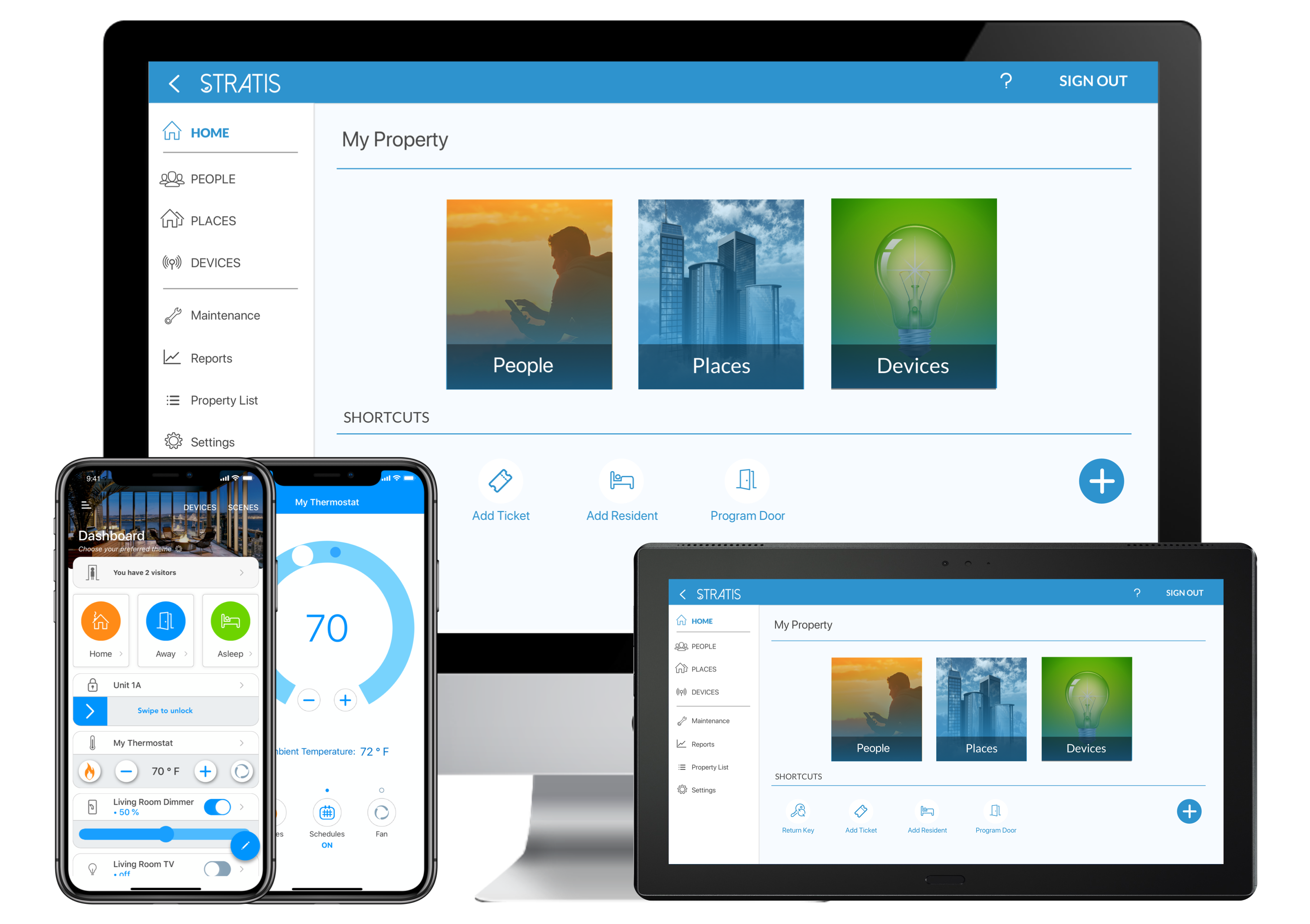
RealPage, a publicly traded full-service property management technology firm with over 12,200 clients worldwide, today announced that it has acquired Stratis IoT,  a startup that provides IoT services to the real estate industry, with a focus on access and energy management tools.

“RealPage aims to become a leading provider in the burgeoning rental property automation market, and thereby create significant opportunity for operators to increase rents, improve sustainability, add operational efficiencies, reduce operating costs and enhance the customer experience for the company’s approximately 19 million units throughout the United States,” said RealPage CEO Steve Winn. “The smart building technology also provides a launching pad for expanded international operations, thanks to Stratis’ existing international presence.”

Stratis is currently installed in about 380,000 homes in the U.S., Japan, UK and several countries in Europe and Latin America. Both Stratis and RealPage target a wide range of the real estate industry, ranging from multifamily units to student housing, vacation homes and commercial real estate.

Image Credits: Stratis

Traditionally, the real estate market wasn’t always the first to adopt modern technologies. That’s quickly changing now, though, in part because of the promise of IoT, which isn’t just a boon to renters looking for modern solutions in their apartments but also represents the possibility of significant cost savings for the industry. RealPage argues that smart technology can generate a revenue lift of $55 per unit, for example, and that’s the kind of saving (and higher revenues) that will push even legacy B2B platforms to modernize.

One area where Stratis stands out is its ability to integrate with a wide variety of third-party solutions.

“Holistic building-wide access and utility management and control are integral to building optimization and the resident experience, which have become increasingly intertwined,” said Stratis IoT CEO Felicite Moorman. “RealPage and Stratis IoT combine two industry-leading, best-in-class platforms to create a powerhouse of control and single-app resident experience for multifamily, student housing, and beyond.”

The two companies did not disclose the price of the acquisition. It’s worth noting that RealPage isn’t a stranger to making acquisitions to bring its technology up to speed. A year ago, the company acquired Hipercept, for example, a firm that provided data services and data analytics to the institutional real estate market. Then, in December, it also acquired Buildium, a SaaS property management solution with over 2 million units under management. In 2019, the company said planned to spend just over $100 million on acquisitions.


from Startups – TechCrunch https://ift.tt/2YNNDwo
via IFTTT