Saturday, 2 May 2020

As lockdowns stretch on, is edtech passing or failing?

Back in January, Georgia Tech professor David Joyner got a cryptic email from a student based in Wuhan, China.

“I’m under quarantine, but my internet access is okay so I have more time to spend on classwork, I wanted to let you know,” the message read. Unsure why Wuhan would be under quarantine, Joyner did a quick Google search and saw the beginnings of the coronavirus pandemic.

“I thought, there’s something going on in Wuhan so maybe we’ll have some students affected by it,” Joyner said. Fast-forward two months and the coronavirus is a household term. All of Joyner’s students, regardless of geography, have been impacted by the pandemic.

It has been a little over a month since colleges and schools across the country started shutting down due to COVID-19. Edtech startups had a surge in usage and a demand for more resources than ever. Now that the adoption scramble has slowed, the same startups are reckoning with unprecedented use cases.

Everyone knows how they’re expected to behave in a physical classroom, but can you stop a student from cheating when taking a test in their bedroom at home? How should teachers offer 1:1 time and take questions during a lesson?

Piazza founder Pooja Sankar says teachers face more open questions: “What does it mean to record myself? What does it mean to have a camera on my face? How do I know I can hold a class with reliable internet connection?”


from Startups – TechCrunch https://ift.tt/2SqjW0V
via IFTTT

Friday, 1 May 2020

Mark Cuban: ‘Raising money isn’t an accomplishment, it’s an obligation’

Mark Cuban isn’t impressed that you’ve raised money.

“If you think the accomplishment is raising money first, we’re probably not gonna get along,” said Cuban in an Extra Crunch Live interview. “If your orientation is ‘I got to raise the money first,’ you don’t really have a company yet, and you really haven’t accomplished anything yet. […] Sweat equity is the best equity.”

We also got his take on today’s economy, the nation’s direction and his notes on what startups should do to survive in the new world. Happily, as we had an hour to chat, we managed to cover a lot of ground. The full conversation (YouTube) is after the jump, and we’ve excerpted a number of quotes for your perusal.

But up top we wanted to share Cuban’s notes regarding which companies should accept Paycheck Protection Program (PPP) funds from the Small Business Administration. The matter became a hot-button issue in and around Silicon Valley, where initial debate centered around which startups could access the money. After it became clear the first installment of PPP funds wasn’t going to last, whether startups should access to the capital at all became a question. Some venture-backed companies even decided to return their PPP check.

According to Cuban, when PPP was first put together, the market’s “perspective was that there’d be plenty of money for everybody. You know, people didn’t really want to do the math.” Cuban said that if there was $350 billion in the pot and one million small businesses, the fund would have worked out to $350,000 apiece. “Well guess what,” he said, “there are 30 million companies, [and] like 20 of them are independent contractors.”

Once you did the calculations again with that many companies eligible for PPP funds, you could tell that the money wasn’t going to last. So Cuban told firms that he’s invested in where he has sway to “either not apply or just pay it back immediately.” Why? “For the betterment of the country and the economy,” he said, adding that “if you do have access to capital” or “your business isn’t dramatically impacted [then] let’s leave [the PPP money] for the people who need it the most.”

As noted, the full video is below (you can join Extra Crunch here!), along with Cuban’s notes on startup advice during the pandemic, American 2.0 (and Marc Andreessen’s essay), AI, pre-seed companies, his future in politics and how to pitch him.

Mark Cuban on the record

How he’s advising portfolio companies during the pandemic:

So first and foremost, communicate. Second is be honest. Third is be transparent. And fourth is be authentic. Because everybody is nervous. Everybody is terrified at a certain level. So you just have to recognize that. People are going to need that honesty from you and people are going to want communications from you. That’s been the primary thing around what these companies should do.

Regarding cutting costs: Every business is different. On the smallest ones, they’re already grinding, and it’s typically dependent on the founder. I’ve really tried to encourage people to keep all their employees on if at all possible. That there’s gonna be a lot of change and that’s going to create a lot of opportunity. So, if you can hold on to your employees and push forward in any way, shape, or form, you may have an opportunity.


from Startups – TechCrunch https://ift.tt/35xQmMF
via IFTTT

IPOs, crypto funds and other things I missed this week

Hello and welcome back to our regular morning look at private companies, public markets and the gray space in between.

What a week it’s been. I’m exhausted. Not only are we another cycle deeper into the COVID-19 quarantine, but there seems to be more news than ever to sift through. I’ve fallen behind. So, today, this little column is taking look back at things that it missed but wanted to cover. (There may come a day when we run out of stuff to talk about, but it’s not coming any time soon.)

So let’s about a16z’s new crypto fund, recent economic data, the Ebang F-1, Lime’s layoffs, Procore’s IPO delay and fresh valuation, stocks, Luckin, and, if we have time, Twitter’s changing jobs data. Let’s get this all out of our heads and into the world.

Odds, ends

To annoy my editors, we’re using bullet points this morning. Bullet points are great way to convey a bloc of information in a neat format. Let the haters hate, we have a lot of ground to cover:


  • from Startups – TechCrunch https://ift.tt/3aQwFk9
    via IFTTT

Monzo recruits former Amex exec Sujata Bhatia as its new COO

More personnel changes are afoot at Monzo, as the U.K. challenger bank continues to bolster its leadership team.

Specifically, TechCrunch has learned that Sujata Bhatia, a former American Express executive in Europe, has been recruited as Monzo’s new Chief Operating Officer, replacing previous COO Tom Foster-Carter (who left the bank rather suddenly in November to found a startup of his own). Monzo confirmed Bhatia’s appointment, which is still subject to regulator approval, and I understand she is due to start the COO role in late June.

Prior to Monzo, Bhatia spent almost 16 years at American Express. Her most recent position at Amex was Senior Vice President for Global Merchant Services Europe. Before that she was Senior Vice President of Global Strategy and Capabilities, where, according to her LinkedIn profile, she lead a team of 400 people across 23 global markets.

Bhatia’s appointment follows the recruitment of Mike Hudack, the former CTO of Deliveroo and most recently a founding partner at London venture capital firm Blossom Capital. He joined Monzo in March as the challenger bank’s new Chief Product Officer. Going the opposite way was Meri Williams, Monzo’s Chief Technical Officer, who parted ways with the bank a few weeks later citing her wish to voluntarily help with “cost-cutting measures”.

Meanwhile, Bhatia joins Monzo at a somewhat turbulent time for the challenger bank, as it, along with many other fintech companies, attempts to insulate itself from the coronavirus crisis and resulting economic downturn, meaning that the new COO will likely need to hit the ground running.

Last month, I reported that Monzo was shuttering its customer support office in Las Vegas, seeing 165 customer support staff in the U.S. lose their jobs. And just a few weeks earlier, we reported that the bank was furloughing up to 295 staff under the U.K.’s Coronavirus Job Retention Scheme. In addition, the senior management team and the board has volunteered to take a 25% cut in salary, and co-founder and CEO Tom Blomfield has decided not to take a salary for the next twelve months.

Like other banks and fintechs, the coronavirus crisis has resulted in Monzo seeing customer card spend reduce at home and (of course) abroad, meaning it is generating significantly less revenue from interchange fees. The bank has also postponed the launch of premium paid-for consumer accounts, one of only a handful of known planned revenue streams, alongside lending, of course.

With that said, Monzo recently launched business accounts, many of which are revenue generating, with both free and paid tiers. I understand from sources that the number of business accounts opened to date already stands at approaching 20,000.

Related to this, having originally missed out on state aid via the capability and innovation fund designed to introduce more competition in SME banking, Monzo now has a second potential bite of the apple after previous grant winners Metro and Nationwide are returning the money.

As always, watch this space.


from Startups – TechCrunch https://ift.tt/2xoCesl
via IFTTT

Smart home startup Josh.ai raises $11 million to offer a home assistant alternative to Alexa

Directly taking on Google and Amazon generally seems to be an ill-advised strategy for a young startup. It’s even more complicated when you’re competing on the home assistants front, a technically complex, capital-intensive future platform into which both tech giants have dumped substantial sums.

Over the past few years, the small smart home startup Josh.ai has attempted to do just that, capitalizing on public distrust of the big voice platforms to sell an intelligent assistant to users weary of sticking a Google or Amazon-owned microphone in their homes. The company has built its business catering to customers seeking professionally installed pricey outfits in their home, costing upwards of $10,000 on the high end.

The company just secured its largest funding round to date, an $11 million Series A round, which brings the startup’s total funding to $22 million. A spokesperson for Josh.ai said their investors have asked not to be named, though he confirmed the round was led by corporate investors.

For people with an Echo Dot or Google Mini in their home, Josh.ai’s approach feels familiar. The platform boasts a number of third-party integrations, so you can use the platform to switch off lights, turn on devices, play music and answer some simple commands. Basically, the bulk of home-centric commands popular on Google Assistant and Alexa.

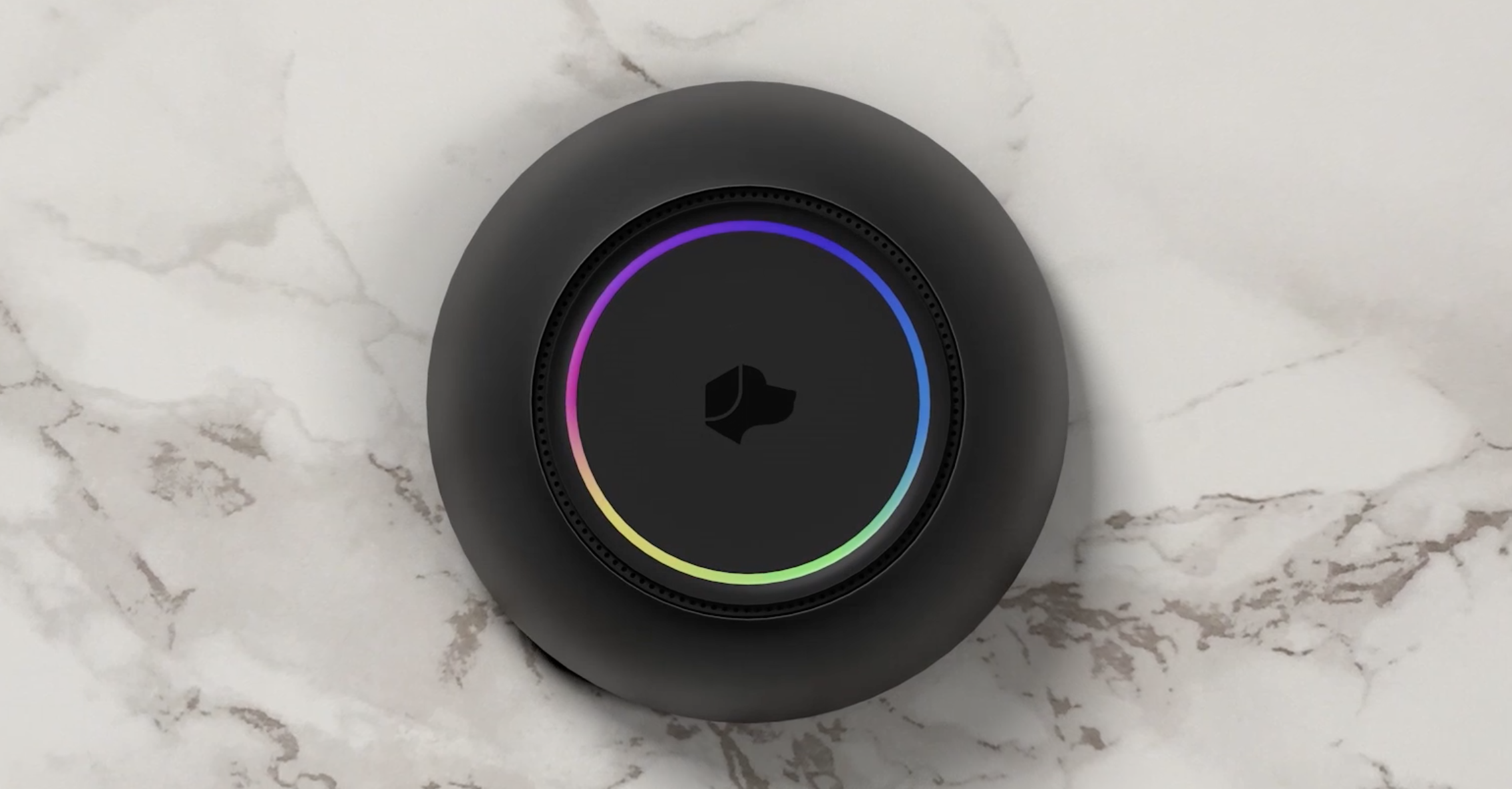
The startup recently introduced Josh Micro, its own take on the Echo Dot. It has a futuristic vibe and, because it’s installed by professionals, users are privy to a sleek look with wires neatly tucked away inside walls. CEO Alex Capecelatro says their competitors in the professionally installed space have been pushing wall-mounted screens with UIs that often aren’t updated and don’t age well. He hopes their more low-key display-free devices can keep less focus on the hardware and more attention on their software.

“Our philosophy is that you shouldn’t be talking to a puck, it should feel fully immersive,” he says.

Capecelatro had originally seen the best path to existing alongside Google and Amazon as working with them and leveraging their platforms, but he soon found that not working with them proved to be the startup’s biggest asset.

“In terms of direction, what became really clear in the past three years was the importance of privacy,” Capecelatro told TechCrunch. “A lot of our clients are just people who care about their privacy; it’s part of every conversation.”

On the tech side, Capecelatro says the startup’s platform is designed around its own natural language processing stack, so most voice requests can be processed locally, though the startup does leverage tech built by Google and Microsoft to handle speech-to-text processes. While the company uses anonymized data to improve its services, the startup has also introduced specific software features to keep privacy-focused users satisfied including their own take on a smart home incognito mode.

There are few silver bullets in smart home tech, and robust third-party support often leaves room for uncertainty, which in Josh’s case can mean the difference between lights turning on or staying off. Capecelatro says ensuring smooth compatibility with supported devices has been a pretty big focus for their engineering team.

“The more things we work with, the more things we have to QA and the more things that could be impacted,” he says.

While Capecelatro says that around 80-85% of their business goes to single-family homes, he says the startup is starting to find business in commercial sectors, outfitting hotels and condo buildings.

“The reality is we’ve found that the professional installed space is a really big market that the consumer companies don’t really think about,” Capecelatro says. “I think for us the likely future is that we’ll focus on areas where you have a professional installer in a non-residential arena.”

The company says the pandemic has actually given their business a bump, with April being their best month of sales to date as homeowners stuck in their houses look to finally act on long-considered home improvement projects.


from Startups – TechCrunch https://ift.tt/2VRp4h1
via IFTTT

How this startup built and exited to Twitter in 1,219 days

By the summer of 2016, Marie Outtier had spent eight years as a consultant advising media agencies and martech companies on marketing growth strategy.

Pierre-Jean “PJ” Camillieri started as a music software engineer before joining one of Apple’s consumer electronics divisions. Inspired by Siri, he left to start Timista, a smart lifestyle assistant.

When the two joined forces to co-found Aiden.ai, the combination was potent — one was a consummate marketer, the other, a specialist in machine learning. Their goal: create an AI-driven marketing analyst that offered actionable advice in real time.

Humans who manage ad campaigns must analyze vast amounts of numbers, but Outtier and Camillieri envisioned a tool that could make optimization recommendations in real time. Analytics are vast and unwieldy, so theirs was a no-brainer proposition with a market crying out for solutions.

The company’s first office was at Bloom Space in Gower Street, London. It was just a handful of hot desks and a nearby sofa shared with four other startups. That summer, they began in earnest to build the company. A few months later, they had a huge opportunity when the still 100% bootstrapped company was selected for Techcrunch Disrupt’s Startup Battlefield competition.

Interviewed by TechCrunch, they explained their proposition: Marketers wanted to know where a digital marketing campaign was getting the most traction: Twitter or Facebook. You might need to check several dashboards across multiple accounts, plus Google analytics to compile the data — and even if you conclude that one platform is outperforming the other, that might change next week as users shift attention to Instagram, potentially wasting 60% of ad spend.

Aiden was intended to feel like just another co-worker, relying on natural language processing to make the exchange feel chatty and comfortable. It queried data from multiple dashboards and quickly compiled it into flash charts, making it easy to find and digest.

Eventually, instead of managing 10 clients, marketing analysts would be able to manage 50 using dynamic predictions as well as visualizations. Aiden incorporated Outtier’s expertise into its algorithms so it could suggest how to tweak a Facebook campaign and anticipate what was going to happen.

Was appearing at Disrupt a significant moment? “It was a big deal for us,” says Outtier. “The exposure gave us ammunition to raise our first round. And being part of the Disrupt Battlefield alumni gave us many meaningful networking and PR opportunities.”

A few weeks later the company had raised a seed round of $750,000. But not without difficulty. By this time Outtier was in the latter stages of pregnancy. Raising money under these circumstances was difficult, but, she says, “it can be done. It’s tougher than ‘normal circumstances.’ It’s a bit like running a marathon, but with a fridge on your back.”


from Startups – TechCrunch https://ift.tt/2WcivEG
via IFTTT

Plantible raises $4.6 million seed round for an egg white replacement that isn’t aquafaba

When California announced a statewide lockdown, Tony Martens and Maurits van de Ven decided to stay put instead of heading home to Amsterdam.

So, the co-founders of Plantible bought two trailers and started living at their HQ: a two-acre duckweed farm in San Diego.

Plantible uses duckweed, a tiny aquatic leaf, to extract a plant-based protein ingredient that will eventually allow food companies to make animal-based products into plant-based products. The offering would be attractive to companies that make baked goods or protein powder, and thus use lots of egg whites as part of their creation process.

The startup is selling a whey or dairy protein replacement, and is still working on FDA approval.

“We are firm believers that whatever is in nature should be sufficient to provide humanity the ingredients they need,” said Martens from the office trailer.

The startup recently did a series of trials with companies, and Martens says that Plantible validated it can be a replacement with baking ingredient companies and plant-based meat sellers. But the startup is not limited to current use cases.

“If the sector we had our eyes on is taking a while, but sports nutrition is taking off really fast, we’ll go there,” said Martens. “We need to prove the feasibility of our company.”

The trailers where Plantible co-founders have sheltered in place amid COVID-19 lockdowns.

Plantible is entering a crowded space. Recently, aquafaba, the liquid made from a can of chickpeas, has regained popularity amid other quarantine cooking hacks. Martens says that aquafaba might recreate foaminess, but it doesn’t recreate gelation (or the sizzle and fry look that comes when you pour a real egg white into a hot pan). Plantible claims to offer an egg-white replacement with no compromises on texture or nutrition.

The startup also has some increasingly well-funded alternative protein competitors. Plantible’s closest venture-backed competitors are Clara Foods and FUMI Ingredients, as both try to create egg-white replacements. Clara Foods uses yeast, instead of chickens, to make egg whites, and similarly sells to businesses that use egg whites in large quantities for items like macaroons, angel food cake and protein powders. It has the backing of Ingredion, a global ingredients solution company.

Plantible needs to have a faster, cheaper and more scalable operation to beat its competitors. From a supply perspective, Plantible is in a good place. Duckweed doubles in mass every 48 hours and grows year-round. Plus, it is more digestible than pea, soy or algae, the company claims.

The real expense comes from the extraction process.

Right now, Martens admits, Plantible is “lab scale, and lab scale is really expensive.”

To bring costs down, the company just raised a $4.6 million seed round, co-led by Vectr Ventures and Lerer Hippeau. Other participants include eighteen94 Capital (Kellogg Company’s venture capital fund) and FTW Ventures.

Plantible co-founders Maurits van de Ven and Tony Martens (from left to right).

Through the new capital, Plantible claims it will be cost-competitive with egg whites. Currently, two pounds of liquid egg whites cost $8 to $10 dollars to make and sell for $15 to $20 dollars.

“In the end it is about developing a scalable and cost-competitive supply chain that produces a desired ingredient. Since it is very hard to compete with nature, we have decided to embrace it as much as possible by identifying a highly functional and nutritional enzyme,” he said.

“The more you can leverage nature, the more scalable you become,” he said.

As with any seed-stage alternative-protein company, the proof that Plantible has legs to succeed will be in sales and capacity to produce. And it’s not quite there yet.


from Startups – TechCrunch https://ift.tt/2KP0PcY
via IFTTT