Tuesday, 3 December 2019

Salv, the anti-money laundering startup founded by ex-TransferWise employees, picks up $2M seed

Salv, an anti-money laundering (AML) startup founded by former TransferWise and Skype employees, has raised $2 million in seed funding.

The round is led by Fly Ventures, alongside Passion Capital and Seedcamp. Angel investors also participating include N26 founder Maximilian Tayenthal (who seems to be doing quite a bit of angel investing), Twilio CTO Ott Kaukver, and Taavi Kotka, former CIO for Estonia (the actual country!).

Founded in June 2018 and initially offering consultancy, Estonia-based Salv has built a software platform that helps banks find and stop financial crime. The idea, says co-founder and CEO Taavi Tamkivi, is to move AML beyond just compliance to something more proactive that actually does defeat crime. That’s quite the promise, although he and his co-founders have a lot experience to draw from, both within fast-growing startups and AML.

Tamkivi built the AML, fraud, and Know Your Customer (KYC) teams at TransferWise and Skype. COO Scott McClelland also worked in the anti-fraud team at Skype, followed by a stint at TransferWise, first as an analyst and then in HR. And CTO Sergei Rumjantsev was also formerly at TransferWise, leading the engineering team responsible for KYC and verification.

“This was a highly demanding role, especially given how fast TransferWise was growing, how many new markets were coming online, and how central user verification is for compliance,” Tamkivi tells me. “Under Sergei’s leadership, the team made the verification process incredibly smooth over time for genuine customers. But also robust enough to protect TransferWise from on-boarding bad actors”.

Bad actors within financial services are aplenty, of course. Yet, despite the European banking sector spending billions tackling the problem, it is estimated that only 1-2% of global money-laundering is detected.

“AML should be all about stopping money laundering but, particularly in the last decade, layer upon layer of regulations have been added for banks to comply with,” says Tamkivi. “This would be great if that meant that there was no more money laundering, but sadly, that’s a long way off. Today, between $1-2 trillion a year is still laundered. But the excessive regulations mean that nearly all of a bank’s compliance team’s effort goes into compliance. They have very little energy left to actually focus on improving their financial crime-fighting abilities. The software they’re using is similar, focused almost wholly on compliance, not crime-fighting”.

That is where Salv wants to step in, and Tamkivi says the main difference between the startup’s AML software and other existing solutions is a much greater emphasis on crime-fighting rather than a box-ticking compliance exercise.

“We’re aiming to create a transformation similar to what’s happened in virus scanning,” he says. “10-15 years ago virus scanners on everyone’s PCs were an enormous hassle, consumed tons of resources and stopped you from getting work done. The same is true in financial institutions today. They’re using outdated, heavy software and processes to handle AML. But today, virus scanning still happens, but nobody’s worried about it. It happens in the background, with few resources. We’ll do the same in the AML world”.

In addition, the Salv CEO claims that the company’s software is faster than competitors’ offerings, both in terms of set up time and integration, and making changes to the rules the system adheres to.

“Our system, by contrast, takes a month or less to set up and minutes to modify the rules,” he says. “As a result, our customers can take everything they learn today from new criminal patterns, encode it in automated rules tomorrow, and repeat that cycle every day to protect their bank. Moving fast is the only way to keep up with the innovative organised criminals moving millions or billions around the world”.

To that end, Salv already counts Estonian bank LHV as its first customer. “They offer a full suite of banking products across Estonia,” says Tamkivi. “They’re also active in London, in particular, supporting fintechs. We have another couple of customers in the Lithuanian fintech scene. One of those is DeVere e-Money”.

More generally, Salv’s product is said to be suitable for Tier 2 and Tier 3 banks, as well as regulated fintechs and challenger banks.

Meanwhile, the business model is straightforward enough. Salv charges a monthly subscription, while the price varies based on the number of active customers a bank or fintech has.


from Startups – TechCrunch https://ift.tt/2YcQxch
via IFTTT

Xometry acquires European on-demand manufacturing marketplace Shift

Xometry, the U.S.-based marketplace for on-demand manufacturing that raised $55 million in Series D funding this summer, has acquired Munich-based Shift as a path to European expansion.

Exact terms of the deal remain undisclosed, although the exit sees at least some of Shift’s investors, such as Cherry Ventures, picking up shares in Xometry. I also understand the Shift team is staying on and the company’s founders, Albert Belousov, Dmitry Kafidov and Alexander Belskiy, will now be heading up Xometry’s newly formed European business.

Specifically, via this acquisition, Xometry says will accelerate international expansion into 12 new countries, leveraging a now worldwide network of over 4,000 manufacturers. The company’s on-demand manufacturing marketplace is already used by global companies like BMW and Bosch, which are Europe-based, and so it makes sense to have a much stronger operations in the continent.

“We’re eager to leverage Xometry’s technology to continue to scale our business in Europe,” says Shift’s Kafidov in a statement. “We look forward to providing our customers additional manufacturing capabilities, including additive manufacturing and injection molding”.

Shift claims to have built the largest on-demand manufacturing network in Europe and a customer base that includes some of the leading manufacturing companies in the region. Now operating as Xometry Europe, the subsidiary will continue to be headquartered in Munich in Germany, an area known for its manufacturing heritage.

Cue statement from Christian Meermann, Founding Partner, Cherry Ventures: “The custom manufacturing industry is a massive global market of over $100 billion. We’re excited for Shift to utilize Xometry’s industry-leading technology as well as leverage the global manufacturing expertise from other Xometry investors, including BMW i Ventures and Robert Bosch Venture Capital”.

Xometry has raised $118 million since being founded in 2013. Over the past two years, the company has grown from 100 employees to over 300 while more than doubling revenue each year. Via its partner manufacturing facilities, the company offers CNC Machining, 3D Printing, Sheet Metal Fabrication, Injection Molding, and Urethane Casting.

Contrast that with Shift, which was founded in 2018 and had raised around €4 million (~$4.4m) to date. Sources also tell me that the startup had nearly closed a Series A round before Xometry preempted the investment by making an acquisition offer.


from Startups – TechCrunch https://ift.tt/2P8KTUp
via IFTTT

Cuvva raises £15M Series A to launch flexible monthly car insurance

Cuvva, the app-based insurance provider that began life offering pay-as-you-go driving cover but has since expanded to also sell travel insurance, has raised £15 million in Series A funding.

Backing comes from RTP Global, Breega, and Digital Horizon, joining existing investors LocalGlobe, Techstars Ventures, Tekton and Seedcamp. A number of angels also joined the round, including Dominic Burke, the CEO of Jardine Lloyd Thompson, and Faisal Galaria, the former chief strategy and investments officer of GoCompare.

Launched in 2016 when founder Freddy Macnamara (pictured) become frustrated he couldn’t let others drive his car intermittently because of lack of insurance cover, Cuvva was an early pioneer of pay-as-you-go car insurance.

The idea, which was easier explained than done, was to make it possible to insure a car only when it was being driven, and therefore be cheaper for low mileage drivers, and via an app and access to the DVLA database, make it easier to on-board new drivers for pay-as-you-drive cover.

The insurtech still offers hourly car insurance but its product line has since been expanded to daily covery, as well as a product specifically aimed at learner drivers. In addition, Cuvva entered the travel insurance space, no doubt spotting overlap with its presumably younger, millennial demographic.

To that end, Cuvva says it will use the new capital to launch a new pay-monthly motor product in early 2020 that it says could cut average annual bills for car owners “significantly”. It will do this by cutting out various middle people, including brokers and comparison websites, which it says charge insurers about £70 on each policy sold.

“Unlike legacy insurers, Cuvva will not charge a fee to spread payments over the year and it will not penalise loyal customers with dual pricing,” says the startup. Cuvva also says it will offer the same savings, whether you are signing up as a new customer or a returning customer, and won’t charge admin fees to alter personal details registered with your policy.

Cue canned statement from Macnamara: “”I started Cuvva when I couldn’t find flexible insurance to help me share my car. Four years on from launch we are still discovering how big the problem we are solving really is. We’re now selling 3% of all UK motor insurance policies but we’ve got so much further to go. Cuvva is going to be the place where you buy all your insurance, all through our mobile app”.


from Startups – TechCrunch https://ift.tt/35YeHu0
via IFTTT

Penta, the German business banking challenger, partners with SumUp to target offline businesses

Penta, the Berlin-based business banking challenger that also now operates in Italy, has partnered with BBVA-backed card reader company SumUp in a bid to attract more offline businesses.

Up until recently, Penta had been targeting digital businesses, such as startups and e-commerce SMEs, but has since re-positioned itself for wider business banking appeal.

By partnering with a POS provider offering easy card reader-enabled payments, the German challenger bank wants to extend that of offline, such as restaurants, craftsman, healthcare and architects.

Specifically, Penta says businesses can order a SumUp Card Reader via Penta, and in doing so will save money on the initial SumUp setup fee and be able to seamlessly integrate SumUp-powered payments with their Penta account.

They’ll also get access to the existing Penta features, such as being able to open a business banking account entirely digitally, issue multiple payment cards, grant limits and permissions per card for staff, facilitate expense management and integrating with popular accounting tools.

In future, the SumUp integration is planned to go deeper. This will include the ability to use SumUp payments data to forecast future sales and feed into a businesses credit worthiness when they seek a loan.

“One request that we’ve had since day one has been for our customers to easily and quickly accept card payments, so we are very proud to be able to offer this with our newest partner SumUp,” says Penta CEO Marko Wenthin in a statement.

Adds James Henry, Head of Sales and Partnerships at SumUp: “By cooperating with Penta, we will enable even more small and medium-sized companies to digitize their business and make the payment experience as convenient as possible for their customers. Penta, with its growing customer base of companies, is the ideal partner for us to reach the broad mid-market”.


from Startups – TechCrunch https://ift.tt/2P0uKQQ
via IFTTT

Why Notion is staying small as its valuation gets bigger

Work tools startup Notion, which recently reached a reported $800 million valuation, isn’t on the verge of a big SoftBank round. In fact, COO Akshay Kothari says the startup has “never felt like if we had more money we could grow faster.”

The company, centered around an app that helps non-developers build collaboration tools, has more than one million users and has scaled its product quickly despite having a team of just 27.

I wrote about the company’s partnership with some of tech’s top accelerators and venture capital firms last month. People are very curious about this small company and how it is run, so here’s more from my recent interview with COO Akshay Kothari in which we discussed the hyped startup’s philosophy of staying small and some of the challenges it may have ahead with this brand of thinking as competitors are raising massive sums.

This interview has been edited for length and clarity.

Notion COO Akshay Kothari (Photo: Notion)

Notion COO Akshay Kothari (Photo: Notion)

Where does your story begin with Notion? Give me a snapshot of where the team is now.

Akshay Kothari: [Notion co-founders Ivan Zhao and Simon Last] started Notion six years ago and that’s when I invested. I had sold my previous company and I had this newfound money that I didn’t know what to do with. I invested in Notion, so that’s my connection.

We were kind of in research mode for many years trying to uncover what the market needs were. We launched about two years ago; 1.0 was just notes that you could take and a wiki so that you could collaborate with people. And then last year we launched databases and that was the 2.0 version, which kind of seemed like an inflection point, where now you could not only have your notes and your wiki, but also manage your tasks, manage your projects, manage candidates and recruiting, all in a single tool.

Over the last year and a half, the company has grown extremely fast. I joined about a year ago, there were about 10 people at the beginning of this year and now we’re close to 30. It’s still a really small engineering team. We’re 9 engineers, we don’t have any product managers, and we’re 2 designers. So there are about 10 people that are building the product, and 10 people on community and support teams, something that we’ve invested very heavily in. We’re starting to have a sales and marketing team. We have 2 people in marketing and 2 people in sales. That all rounds up to about 27 which is where we are now.

Since you joined do you think the idea has shifted at all?

In terms of the original idea, we were thinking about how people who didn’t know how to code could build things like tools and software that were really useful. I guess the only realization has been that not everyone wakes up wanting to build software, but everyone wakes to solve problems. That was the pivot to focusing on notes, wikis and tasks, because that’s actually something that every team needs.

Are those needs universal for big and small teams?

For the first 100 people you can actually do a lot with Notion. With 30 people, we pretty much run the entire company, except for using Slack for internal communication and Intercom for external communication like talking to customers. Everything else is actually on Notion, like our application tracking system for recruiting inside Notion, our sales CRM is in Notion, our wiki obviously is, our project management as well — no, we don’t use Jira.

For sub-100 businesses, you actually don’t need another tool. When you get to hundreds of people what tends to happens is that some person or some team tends to have a preference for a specific tool. In those situations, Notion plays well with other tools. You can embed things easily. So let’s say Excel or Google Sheets is something that you want to use, you can just embed that inside Notion. So Notion becomes this kind of central nervous system for all of the work that people are doing.

Building on that, one of the things we haven’t done is we don’t do synchronous communication so we’ve stayed away from that because I feel like people like using Slack. On Slack, you can’t actually collaborate on a project… Notion has become a place where you can actually do a lot of your work alongside the synchronous communication.

So, no interest in building a chat or video chat product?

Not in the near term. I think Slack is one of those enterprise tools that people at companies actually like. For a lot of these other tools, we just have to use it, not because we love it but because that that’s what exists.

Notion HQ

Notion’s headquarters (Photo: Notion)

What are the barriers for satisfying the customers with 100+ employees?


from Startups – TechCrunch https://ift.tt/2LgFMRf
via IFTTT

Africa Roundup: Nigerian fintech gets $360M, mints unicorn, draws Chinese VC

November 2019 could mark when Nigeria (arguably) became Africa’s unofficial capital for fintech investment and digital finance startups.

The month saw $360 million invested in Nigerian focused payment ventures. That is equivalent to roughly one-third of all the startup VC raised for the entire continent in 2018, according to Partech stats.

A notable trend-within-the-trend is that more than half — or $170 million — of the funding to Nigerian fintech ventures in November came from Chinese investors. This marks a pivot in China’s engagement with Africa to tech. We’ll get to that.

Before the big Chinese backed rounds, one of Nigeria’s earliest fintech companies, Interswitch, confirmed its $1 billion valuation after Visa took a minority stake in the company. Interswitch would not disclose the amount to TechCrunch, but Sky News reporting pegged it at $200 million for 20%.

Founded in 2002 by Mitchell Elegbe, Interswitch pioneered the infrastructure to digitize Nigeria’s then predominantly paper-ledger and cash-based economy.

The company now provides much of the tech-wiring for Nigeria’s online banking system that serves Africa’s largest economy and population. Interswitch offers a number of personal and business finance products, including its Verve payment cards and Quickteller payment app.

The financial services firm has expanded its physical presence to Uganda, Gambia and Kenya. The Nigerian company also sells its products in 23 African countries and launched a partnership in August for Verve cardholders to make payments on Discover’s global network.

Visa and Interswitch touted the equity investment as a strategic collaboration between the two companies, without a lot of detail on what that will mean.

One point TechCrunch did lock down is Interswitch’s (long-awaited) and imminent IPO. A source close to the matter said the company will list on a major exchange by mid-2020.

For the near to medium-term, Interswitch could stand as Africa’s sole tech-unicorn, as e-commerce venture Jumia’s volatile share-price and declining market-cap — since an April IPO — have dropped the company’s valuation below $1 billion.

Circling back to China, November was the month that signaled Chinese actors are all in on African tech.

In two separate rounds, Chinese investors put $220 million into OPay and PalmPay — two fledgling startups with plans to scale in Nigeria and the broader continent.

PalmPay, a consumer oriented payments product, went live last month with a $40 million seed-round (one of the largest in Africa in 2019) led by Africa’s biggest mobile-phone seller — China’s Transsion.

The startup was upfront about its ambitions, stating its goals to become “Africa’s largest financial services platform,” in a company release.

To that end, PalmPay conveniently entered a strategic partnership with its lead investor. The startup’s payment app will come pre-installed on Transsion’s mobile device brands, such as Tecno, in Africa — for an estimated reach of 20 million phones.

PalmPay also launched in Ghana in November and its UK and Africa based CEO, Greg Reeve, confirmed plans to expand to additional African countries in 2020.

OPay’s $120 million Series B was announced several days after the PalmPay news and came only months after the mobile-based fintech venture raised $50 million.

Founded by Chinese owned consumer internet company Opera — and backed by 9 Chinese investors — OPay is the payment utility for a suite of Opera developed internet based commercial products in Nigeria. These include ride-hail apps ORide and OCar and food delivery service OFood.

With its latest Series A, OPay announced it would expand in Kenya, South Africa, and Ghana.

Though it wasn’t fintech, Chinese investors also backed a (reported) $30 million Series B for East African trucking logistics company Lori Systems in November.

With OPay, PalmPay, and Lori Systems, startups in Africa have raised a combined $240 million from 15 Chinese investors in a span of months.

There are a number of things to note and watch out for here, as TechCrunch reporting has illuminated (and will continue to do in follow-on coverage).

These moves mark a next chapter in China’s engagement in Africa and could raise some new issues. Hereto, the country’s interaction with Africa’s tech ecosystem has been relatively light compared to China’s deal-making on infrastructure and commodities.

There continues to be plenty of debate (and critique) of China’s role in Africa. This new digital-phase will certainly add a fresh component to all that. One thing to track will be data-privacy and national-security concerns that may emerge around Chinese actors investing heavily in African mobile consumer platforms.

We’ve seen lines (allegedly) blur on these matters between Chinese state and private-sector actors with companies such as Huawei.

As OPera and PalmPay expand, they may need to do some reassuring of African regulators as countries (such as Kenya) establish more formal consumer protection protocols for digital platforms.

One more thing to follow on OPay’s funding and planned expansion is the extent to which it puts Opera (and its entire suite of consumer internet products) in competition with multiple actors in Africa’s startup ecosystem. Opera’s Africa ventures could go head to head with Uber, Jumia, and M-Pesa — the mobile money-product that put Kenya out front on digital finance in Africa before Nigeria.

Shifting back to American engagement in African tech, Twitter and Square CEO Jack Dorsey was on the continent in November. No sooner than he’d finished his first trip, Dorsey announced plans to move to Africa in 2020, for 3 to 6 months, saying on Twitter “Africa will define the future (especially the bitcoin one!).”

We still don’t know much about what this last trip — or his future foray — mean in terms of concrete partnerships, investment, or market moves in Africa from Dorsey and his companies.

He visited Nigeria, Ghana, South Africa and Ethiopia and met with leaders at Nigeria’s CcHub (Bosun Tijani), Ethiopia’s Ice Addis (Markos Lemma), and did some meetings with fintech founders in Lagos (Paga’s Tayo Oviosu).

I know most of the organizations and people Dorsey talked to pretty well and nothing has shaken out yet in terms of partnership or investment news from his recent trip.

On what could come out of Dorsey’s 2020 move to Africa, per his tweet and news highlighted in this roundup, a good bet would be it will have something to with fintech and Square.

More Africa-related stories @TechCrunch

African tech around the ‘net


from Startups – TechCrunch https://ift.tt/2sCPCq3
via IFTTT

Atomico Partner Tom Wehmeier reviews ‘The State of European Tech’ 2019 report

Atomico, the European venture capital firm founded by Skype’s Niklas Zennström, has released its latest annual The State of European Tech report, published in partnership with Slush and Orrick.

As part of the report, the authors surveyed 5,000 members of the ecosystem — including 1,000 founders — as well as pulling in robust data from other sources, such as Dealroom and the London Stock Exchange.

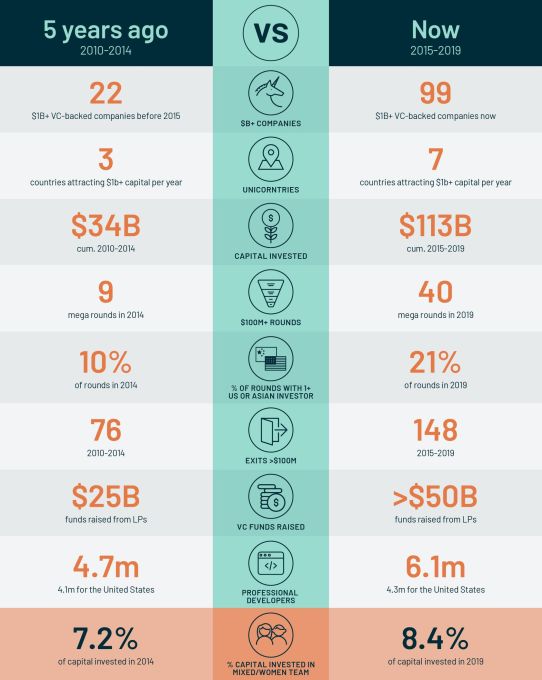
This year, the report reveals that the European tech ecosystem continues to mature and shows no sign of slowing — particularly highlighting the contrast from five years ago when the The State of European Tech report made its debut. Almost every key indicator is up and to the right, except, rather depressingly, diversity.

The data shows, for example, that competition for talent and access to the best founders has increased ferociously. And from a funding perspective, European founders have more choice than ever, especially with U.S. and Asian VC firms investing more and more in the region. Progress with gender diversity stalled, however, such as 92% of funding going to all-male teams.

I caught up with the report’s author Tom Wehmeier, Partner and Head of Insights at Atomico (also sometimes jokingly referred to as the “Mary Meeker of Europe”), where we discuss in more detail some of the key findings and why, it seems, that the rest of the world has finally woken up to Europe’s tech potential.

But first, a few headlines from the report:

  • European technology companies are on track to raise a record 30$B+ in funding in 2019, up from $25B the year before. (Source: Dealroom)
  • Despite failing to match the level of venture-backed exits of 2018, there was a record number of 40 $100M-plus deals as of September 2019, a size that many European tech sceptics did not believe was possible. (Source: Dealroom)
  • A number of multi-billion-dollar non-venture backed companies like Nexi and Trainline made their debut on the public markets.
  • European tech policymaking remains a mystery to many European founders.
  • When asked to describe the top priority of the European Commission in terms of tech policy, 40% of founders and startup employees say they don’t feel informed enough to comment. (Source: survey)
  • Despite this reported lack of awareness on policy issues, all respondents voted EU competition commissioner Margrethe Vestager as the person who had the most influence on European tech in 2019, good or bad. (Source: survey)
  • European parliamentarians aren’t talking about fintech and digital health, two sectors which investors poured a combined $12.7bn into last year (Source: Politico and Dealroom)
  • Europe’s diversity figures are still grim reading.
  • In 2019, 92% of funding went to all-male teams, a similar level to 2018. (Source: Dealroom)
  • There is still only one woman CTO in the 119 companies (<1%) based on a sample of executives in CxO positions at 251 European VC-backed tech companies that raised a Series A or B round between 1 October 2018 and 30 September 2019 with more than $10M funding, even though 7.5% of software engineers are women. (Source: Stack Overflow, Craft, Dealroom)
  • Looking beyond gender diversity, ethnic minorities in tech experienced discrimination at a much high rate than white peers. (Source: survey)
  • At least 80% of Black/African/Caribbean respondents who reported experiencing discrimination linked it to their ethnicity. (Source: survey)
  • 63% of women VCs reported increased focus on attending events with stronger participation from diverse founders. The corresponding number for men VCs was only 33% of female respondents suggested that their male counterparts are leaving female VCs to fix Europe’s diversity problem. (Source: survey)
  • European founders aren’t just aiming for commercial success — they are trying to solve some of the world’s largest problems.
  • One in five European founders states that their company is already measuring its societal and/or environmental impact. (Source: survey)
  • Only 14% of founders don’t believe it’s relevant for their company. Founders that are women are much more likely to be advanced in their approach to measuring impact. (Source: survey)
  • Employees are placing a greater emphasis on corporate social responsibility, with 57% citing its importance in the State of European Tech survey. (Source: survey)

Extra Crunch: It is 5 years since Atomico published the first The State of European Tech report, which really attempted to capture a data-driven snapshot of the entire ecosystem. What are some of the biggest changes you’ve seen within European tech in the intertwining years or in this year in particular?

Tom Wehmeier: If I think back to when we did the first report, people who believe that Europe could actually be an interesting player in global technology, were largely limited to people who were in the tech industry in Europe itself. If you then fast forward to today, what has clearly happened — and I think 2019 was the year where this really materialized and became part of the narrative — was that belief translating from people on the inside to a bunch of people that were on the outside.

Most obviously has been the strength of interest from from the U.S. and the number of top-tier U.S. funds that are not just increasing their level of investment activity but committing to spending more and more time here on the ground, hiring people, building teams, building a network, and getting to know companies. I think it probably surprises people to know that 19% of all rounds this year will involve at least one U.S. investor in Europe, which is more than double since since the first year we did the report.

I think the other thing, where I come back to this idea that now we have finally convinced a certain group of people about the role that Europe can play, is mainstream institutional investors. I know it is not going to be lost on you, [but] this is going to be another record year for VC fund raising from Europe. And whilst the headline numbers might not be a surprise, I think what should catch people’s attention is that the composition of the LP base here in Europe is now shifting. And finally, there’s an unlocking of institutional investors, [by which] I mean pension funds, funds of funds, insurance companies, sovereign wealth funds, who are committing to European VC at levels that are significantly increased and elevated from where they had been in the past. So, if you just take pension funds, we’re going to see close to a billion dollars invested which is up nearly three fold.

It’s a validation of what’s happening around European tech to see that now coming through and I think is ultimately something that helps to build a foundation for the next five years of success. As much as this is a report that’s looking back, it’s also about trying to understand where things go from here.

With regards to the pension funds, do you think that is driven by the general bullishness towards European tech, or do you think it’s more the macro economic reality that maybe other places where they could put their money aren’t very attractive at the moment?

I think it’s really a reflection that there’s a strong level of belief that European venture as an asset class is an attractive investment opportunity. And that is reflected by the numbers. One of the charts that we’ve got in the report is from Cambridge Associates who do the benchmarking for the VC indices… And when you look back over a 1, 3, 5, or even a 10 year horizon, the performance from European VC is demonstrating that this is a place where for anyone building a diversified portfolio, they should have some allocation. I think it’s fundamentally the strength of the investment opportunity. That is the single biggest driver for why you’re seeing this happen.

I think the biggest thing that Europe has been able to prove is that it can take a great idea and turn it into a great company and that company can scale to not just a billion dollar outcome but to a multi-billion dollar outcome and go all the way through into an IPO or into a large scale acquisition. What you’ve seen happen in 2019 is in part A reflection of what happened last year where it was obviously this record year with Spotify, Adyen, Farfetch, Elastic and others that really showed you can go full cycle from start all the way to finish. And that the magnitude of those outcomes can be at a scale that makes them globally relevant.

Are the pension funds shifting their allocation of VC away from other geographies or are they just doing more VC as a whole?


from Startups – TechCrunch https://ift.tt/35Ui8S9
via IFTTT