Thursday, 2 August 2018

Sexual harassment suit filed against Pilot AI co-founders and investor NEA

Rachel Moore, the former Director Of Product at computer vision startup Pilot.AI is suing its co-founders CTO Robert Elliot English and CEO Jonathan Su for sexual harassment, discrimination, retaliation, and wrongful discharge. Pilot.ai’s Human Resources provider Trinet and its Series A investor NEA are also named in the suit filed in San Francisco Superior Court today. The plaintiff, a 24-year-old Master’s graduate of Stanford University, is seeking a trial by jury.

The suit alleges that Su and English created a hostile work environment colored by sexually inappropriate comments, including discussions of pornography, English’s sexual exploits, and that he “participated in an anal sex workshop at Burning Man led by a famous porn star.” Only when Moore agreed to participate in the crude comments was she awarded more status in the company and a $20,000 raise.

English allegedly later invited Moore into his office, closed the door, dropped his pants while talking about his ex-girlfriend, and initially refused to let Moore leave. For rejecting his advance, he then began to retaliate against her in the workplace according to the suit. It states that Moore reported the incident to Su who dismissed the allegations as English being “sexually frustrated.” Su is said to have encouraged Moore to ask English out on a dinner date to resolve the issue, which she eventually declined out of fear for her safety.

Su later urged Moore not to file a formal report about the incident in English’s office because it could “end the company”, according to the suit. She did, prompting an investigation by law firm WilmerHale. Moore agreed to participate only if the law firm remained neutral and did not act as counsel for Pilot.ai. NEA’s Rick Yang, who sits on the board, is said to have overseen the investigation.

The suit calls the investigation “an utter sham and a cover up”. NEA allegedly took the position of refusing to disclose the investigation report claiming attorney-client privilege. Yang is said to have eventually disclosed a summary of the report that confirmed the pants-dropping incident, but found there was nothing sexual about it, and there were no repercussions for the founders. After the investigation, Moore allegedly requested a leave of absence rather than returning to the office where she would have to report to the defendents. When additional leave requests were ignored, she inquired about her employment status, and allegedly ceased to be paid or have access to company systems, and concluded she had been terminated. 

The charges filed include quid pro quo sexual harassment, hostile working environment harassment, discrimination based on gender, retaliation, failure to prevent or correct harassment, aiding and abetting harassment, wrongful discharge, intentional infliction of emotional stress, failure to pay wages, waiting time penalities, and violations of labor and business codes.

Requests for comment from English, Su, Pilot.ai, NEA, and Trinet were not returned before press time. Moore’s law firm Arena Hoffman LLP issued this statement to TechCrunch from its attorney’s Ron Arena:

“As alleged in the complaint, Ms. Moore contends that she was subjected to a sexually charged workplace, where Pilot AI’s founders discussed anal sex workshops, boasted of sexual conquests on Tinder, named a server ‘Deep Head,’ and let executives drop their pants in a meeting and call Ms. Moore’s footwear ‘fuck me boots.’  Ms. Moore alleges that her complaints were ignored, then swept aside in a sham investigation – after she declined the CEO’s direction to meet her pants-dropping supervisor alone on a dinner date.”

We’ll have more info as it becomes available and will update with comments from the parties involved.


from Startups – TechCrunch https://ift.tt/2LPzp8X
via IFTTT

Fashionably AI

This summer’s wedding season required me to buy a new suit. I vowed to be adventurous and buy a color I normally never would have considered. Alas, I opted for a little more movie-theater usher and a little less Jidenna. Had I known about it at the time, I probably would have used Eison Triple Thread, a company that specializes in creating made-to-order suits.

Working with someone to create a suit can be a hard enough task. You have to consider the occasion the suit is for, body type, taste and other relevant factors. And what other suit company or department store doesn’t already do that? To differentiate itself from the crowd, Eison Triple Thread launched FITS, a web application that creates tailored looks based on clients’ lifestyles and musical preferences.

Eison founder and CEO Julian Eison was the fly kid on the playground and says his parents instilled in him a sense of presentation and to be his best when he was out and about.

“In terms of style and color I was super deliberate about what I wore,” he says. “I was the kid who collected Jordans and wanted to be fashionable because I just cared. I think through that process, and as I grew, I just started to embrace it.”

After six years in private equity, where he says he was able to see tech’s flow from the buy side and the sell side, Eison decided to combine his love of fashion and interest in tech. In 2014, he launched Eison Triple Thread from the garage of his San Francisco home to try his hand at creating an alternative to suit-buying at conventional big-box department stores.

“When we first launched the business, it was about visualization,” Eison says. “How can you visualize your body and think about something going on your body that fits you well?”

But Eison Triple Thread isn’t the only suit company that wants to outfit its customers in sleek styles in a made-to-order fashion. The likes of Indochino, Bonobos and Stitch Fix, all of which came before Eison Triple Thread, ultimately have the same goal. So what’s a suit company do to strike a difference between its competitors? Why, integrate artificial intelligence and Spotify data, naturally.

“Music is at the core of a lot of everyday life; it knows no boundaries or color, and it reveals something about us that we may not know that we kind of project onto people,” Eison says. “So we’re trying to get to the core, the unadulterated piece, and that’s music, and it drives a lot of our decisions, selections, identities and moods.”

During the onboarding process, users first log in to the FITS system with their Spotify credentials and take a lifestyle quiz. Questions include in which industry you work, how you dress for work, what your work commute is, how you spend your free time and which word best describes you. Eison says they can start generating data from this basic information.

“We’ve turned that into a lifestyle quiz that aims to reveal as much about a person in terms of their fashion, their interests, their preferences and how they typically like things to fit. That goes into our analysis and allows us to home in on this fit and this style.”

[gallery size="medium" ids="1681262,1681261,1681263,1681264,1681265,1681260"]

While you’re busy thinking about yourself to the best of your ability, FITS is trolling Spotify through its API to gather data about your musical tastes: genre, when you tend to listen to music and for how long. The process from beginning to end takes only about 15 minutes — unless, like me, you have a hard time selecting just one word from a list of four to describe yourself. Reflective, intense, upbeat, energetic: I am all of these things.

Once you complete the quiz, the web app returns a list of “looks,” as Eison calls them, based on data gleaned from your best answers to these questions. The looks come from a collection of images that Eison and product director Dario Smith curate regularly from the internet based on styles they deem worthy. Eison tells me they currently have 3,000 images in their database and curate additional ones seasonally to kick back to customers on a regular basis.

They pull the metadata of photos, including color pairing, assumed cloth texture and other similar data, which the algorithm uses, Eison says. In the next release, he said the company will be able to identify skin tone for those who upload the required photos. In addition, the company uses available photo metadata to understand geography of fashion. When available, Eison says, they are able to gain insight into local fashion and trends to further tune the algorithm.

“If there are X amount of styles, we want to make sure we have representation,” Eison says. “We can aggregate all these images and then serve those periodically based on how important or relevant they are.”

For my part, I answered the questions while Spotify worked in the background to make sense of my musical predilections: showtunes (your Hamiltons, your Ragtimes, your Cabarets), Jidenna, Calle 13, selections from Moana (yeah, that’s right), Nathaniel Rateliff & the Night Sweats and a smattering of old R&B.

The result was a list of 25 photos of men of varying ages, races and sizes in a wide range of suits pulled from the Eison database (see five of them below). I was excited about most of them, although there were a few too many double-breasted ones for my liking. That’s on me, I suppose, but I don’t think that’s a look I can pull off. Or maybe that’s the point of a system like this: To present something to someone that he or she might not think they’d ever look good in or visualize themselves even wearing.

[gallery ids="1681254,1681255,1681256,1681257,1681258"]

Once you select the look you want, there might be further details to tend to, such as number and style of jacket buttons, button-hole color, the color and fabric of the jacket lining, waistband style on the pants and anything else you can possibly think of. One thing I could see in the future is the ability to place these looks on a picture of myself.

Once you make all of these very permanent decisions, you then have to be measured. Or measure yourself if you opted to do this at home. I was in the Eison studio, so Smith did the honors, measuring me in places I never thought needed to be measured. For instance, they noted posture, as well as the way my arms rest on the side of my body. Suddenly I realized why the clothes I’ve worn my entire adult life never fit me very well.

About two weeks later, you have a suit that you picked out not from a rack but one suggested for you based on your lifestyle and musical tastes. And it will fit only you. My suit fits. But because it’s tailored with my measurements, I’m not so surprised by that. The treat here is the unique application of Spotify and machine learning. Having the FITS system tell me to avoid buying a light gray suit is the permission I needed to step outside of my fashion comfort zone and don a look I most likely never would have otherwise. 

Not bad for a music-streaming platform and a little AI-style effort.


from Startups – TechCrunch https://ift.tt/2OvmdEJ
via IFTTT

Pico nabs $24.7M to create VR hardware that challenges Facebook, Google

While there aren’t many VR hardware startups raising cash out there these days, there are far fewer that are securing investments to actually build the VR headsets themselves.

Even as established tech giants are having a rough go-ahead with the headset market, Beijing-based Pico Interactive is looking to give it a go with a focus on standalone VR headset hardware that can keep up with the innovations of larger firms.

Pico has closed a $24.7 million Series A led by GF Qianhe and GF Xinde Investment, with participation from Jufeng S&T Venture Investment and others, the company said in an announcement. This is the startup’s first bout of outside funding since its founding in 2015.

VR hardware had plenty of entrants around Pico’s founding, but as Oculus competitors were forced to slash prices to keep up with aggressive pricing, margins disappeared, leaving relatively scant space for startups. Pico has made its bet on moving past PC or console-based systems and focusing strongly on self-contained standalone headset options.

Coinciding with the funding announcement, Pico also offered details on a new standalone headset being released in China. Called the Pico G2, it’s an updated version of the Pico Goblin that is built on Qualcomm’s 835 chipset. The company’s hardware runs on HTC’s Vive Wave VR platform.

The company also says that it is planning to release its own augmented reality hardware in 2019.


from Startups – TechCrunch https://ift.tt/2v8P5ul
via IFTTT

Wednesday, 1 August 2018

DoorDash CEO Tony Xu to deliver startup lessons at Disrupt SF

On-demand delivery is painfully difficult. The margins are usually razor thin, each market is wildly different, and the business can be largely dependent on retailers’ willingness to jump into the digital age.

But DoorDash, which launched in 2013 out of Y Combinator, has been a dominant force in the space.

That’s why we’re absolutely thrilled to have DoorDash CEO Tony Xu join us at Disrupt SF in September.

In the five years since it’s launched, DoorDash has expanded to hundreds of markets in the U.S. The company, which offers delivery services for restaurants, liquor stores, and even gadget retailers like b8ta, has also penned partnerships with big retailers like Walmart for grocery delivery.

In fact, DoorDash has raised more than $700 million and has achieved unicorn status in its relatively short life.

Much of that success can be attributed to founder and CEO Tony Xu. The son of immigrants, Xu worked in his parents’ restaurant before heading off to Stanford. He then worked at McKinsey, eBay, and Square before bringing his knowledge and experience into the entrepreneurial realm.

This isn’t the first time we’ve hung out with Xu on the Disrupt stage. In 2016, Xu’s biggest focus was balance.

“Hardest part is keeping everything in balance,” he said. “There’s a couple dimensions to this: how do you invest the company’s capital effectively; how do you best serve the marketplace of three audiences, consumers/merchants/dashers; and how do you keep that in check. If you have too many of one, it’s a challenge, and we have the unique challenge where we have to solve product market fit across three audiences.”

While that challenge will always be a factor in DoorDash’s business, we’re particularly interested to hear about the company’s move into the evolving world of grocery delivery. There is plenty to discuss with Xu, and we hope you will join us at the conference, which runs September 5 to September 7.

The full agenda is here. Passes for the show are available here.


from Startups – TechCrunch https://ift.tt/2LTz8le
via IFTTT

Subscription startup Kidbox launches its own clothing lines

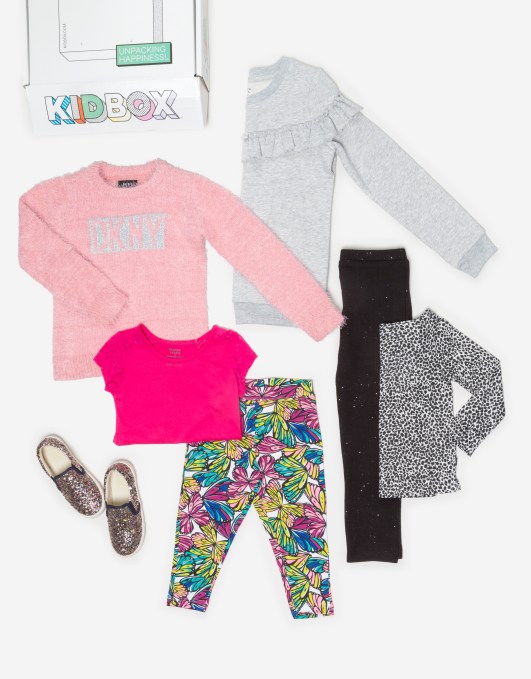
Kidbox, a subscription clothing box similar to Stitch Fix – but aimed at parents who dislike kids’ clothes shopping (aka all of us) – is now launching its own private label kids’ brands. At launch, the three clothing brands – Miki B., Kid’s Club, and Baby Basics – will join the startup’s over 130 existing brand partners, such as Adidas, DKNY, 7 for All Mankind, Puma, Jessica Simpson, Reebok, Diesel and others.

The company had said earlier this year that it would soon be branching out into its own brands with the arrival of its fall 2018 back-to-school box.

Having sent out its first box of clothing during the back-to-school shopping season in 2016, Kidbox now has two years of data under its belt to inform its designers what kids clothing is selling. Its boxes, similar to Stitch Fix, are put together after parents fill out a profile. The offer their kids’ sizing information, age, and what sort of styles, colors and patterns, they like and hate. Kidbox then preps a box accordingly, and anything the child doesn’t want – or mom or dad don’t want to buy, that is – can be sent back.

However, Kidbox heavily incentives its customers to keep the whole box – it’s around half a dozen items for under $100, which is reasonable. In fact, it can cost more to return items, as you then pay the price on the tag instead of receiving the whole-box discount.

With its new private labels, Kidbox aims to grow its margins further.

“We believe we’ve identified a void in the children’s apparel marketplace,” Kidbox CEO Miki Berardelli told TechCrunch this spring, when referencing its plans to sell its own clothing. “The style sensibility of our exclusive brands will all have a unique personality, and a unique voice that’s akin to how our customers describe themselves. It’s all really based on customer feedback. Our customers tell us what they would love more of; and our merchandising team understands what they would like to be able to procure more of, in terms of rounding out our assortment,” she said.

The company at the time was fresh on the heels of a $15.3 million Series B focused on scaling the business, which included bringing the new lines to its customers.

Kidbox’s brands will focus on the four main personality types of Kidbox shoppers, the company now explains. Miki B. represent a sort of “city cool” aesthetic, while Kid’s Club will encompass sporty athletic, modern casual, and classic preppy styles. Baby Basics, of course, includes baby items.

The lines were created by Kidbox’s own design team, which includes designers from brands like Tory Burch, Burberry, Bonobos, and J.Crew. The team focused on every aspect – like  fabric, color, pattern, and cut. They decided on using 100 percent cotton jersey, so the clothes will hold up and become wardrobe staples.

Each Kidbox shipment will now feature at least one of its own brands, the company says.

In addition to the new brands, Kidbox also teamed up with French Toast on a $68 uniform box for boys and girls that caters to kids whose schools enforce dress codes.

Kidbox today competes with other kids clothing subscription boxes like Rockets of Awesome, Kidpik, Mac & Mia, fabKids, and others. As a parent and customer of a couple of these, what I like about Kidbox is the wearability its items, which tend to be more practical choices, and its affordability. My child likes that the Kidbox often comes with a small surprise – and always includes crayons and stickers, too.

The company declines to share subscriber numbers, but touts 1.2+ million members of its “community” which encompasses social media fans, email subscribers, and paying customers.

The New York-based startup has $28 million to date from Canvas Ventures, Firstime Ventures, HDS Capital, plus strategic partners Fred Langhammer, former CEO of The Estée Lauder Companies Inc., and The Gindi Family, owners of Century 21 department stores.


from Startups – TechCrunch https://ift.tt/2KgArpm
via IFTTT

Test.ai nabs $11M Series A led by Google to put bots to work testing apps

For developers, the process of determining whether every new update is going to botch some core functionality can take up a lot of time and resources, and things get far more complicated when you’re managing a multitude of apps.

Test.ai is building a comprehensive system for app testing that relies on bots, not human labor, to see whether an app is ready to start raking in the downloads.

The startup has just closed an $11 million Series A round led by Gradient Ventures, Google’s AI-focused venture fund. Also participating in the round were e.ventures, Uncork Capital and Zetta Venture Partners. Test.ai, which was founded in 2015, has raised $17.6 million to date.

“Every advancement in training AI systems enables an advancement in user testing, and test.ai is the leader in AI-powered testing technology. We’re excited to help them supercharge their growth as they test every app in the world,” Gradient Ventures founder Anna Patterson said in a statement. “In a couple years, AI testing will be ingrained into every company’s product flow.”

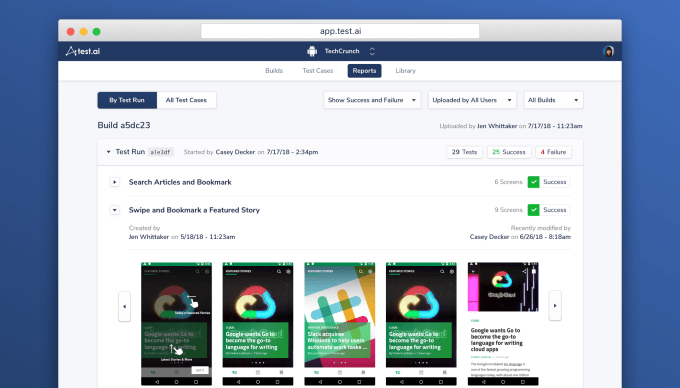
The company’s technology doesn’t just leverage AI to cut down on how long it takes for an app to be tested; there are much lengthier processes it helps eliminate when it comes to developers readying lists of scenarios to be tested. Test.ai has trained their bots on “tens of thousands of apps” to help it understand what an app looks like and what interface patterns they’re typically composed of. From there, they’re able to build their own scenario list and find what works and what doesn’t.

That can mean, in the case of an app like our own, tracking down a bookmark button and then deducing that there are certain process that users would go through to use its functionality.

Right now, the utility is in the fact that bots scale so broadly and so quickly. While a startup working on a single app may have the flexibility to choose amongst a few options, larger enterprises with several aging products having to grapple with updated systems are in a bit more of a bind. Some of Test.ai’s larger unnamed partners that “make app stores” or devices are working at the stratospheric level having to verify tens of thousands of apps to ensure that everything is in working order.

“That’s an easy sell for us, almost too easy, because they don’t have the resources to individually test ten thousand apps every time something like Android gets updated,” CEO Jason Arbon tells TechCrunch.

The startup’s capabilities operate on a much more quantitative scale than human-powered competitors like UserTesting, which tend to emphasize testing for feedback that’s a bit more qualitative in nature. Test.ai’s founders believe that their system will be able to grapple with more nebulous concepts in the future as it analyzes more apps, and that it’s already gaining insights into concepts like whether a product appears “trustworthy,” though there are certainly other areas where bots are trailing the insights that can be delivered by human testers.

The founders say they hope to use this latest funding to scale operations for their growing list of enterprise clients and hire some new people.


from Startups – TechCrunch https://ift.tt/2AoYiDT
via IFTTT

Gusto raises $140 million to go after small business payroll and benefits with more gusto

Gusto, which sells payroll, benefits and human resources management and monitoring services to small businesses, has raised $140 million in its latest round of funding.

The company said it will use the money to add new services to increase payment flexibility for employees. The company launched a new service called Flexible Pay, which gives employees a way to get paid no matter when a company’s pay schedule dictates. It seems sort of like a payday loan, where a percentage of the salary is taken by Gusto for providing money upfront.

The late-stage round was led by T. Rowe Price Associates portfolio, MSD Capital (the family investment fund for Michael Dell), Dragoneer Investment Group and Y Combinator’s Continuity Fund.

Previous investors, including General Catalyst, CapitalG, Kleiner Perkins, 137 Ventures and Emergence Capital, also participated in the round.

The company claims that it processes tens of billions of dollars in payroll and offers a range of benefits, including health insurance, 401(k) plans and college savings plans.


from Startups – TechCrunch https://ift.tt/2O0inCu
via IFTTT